


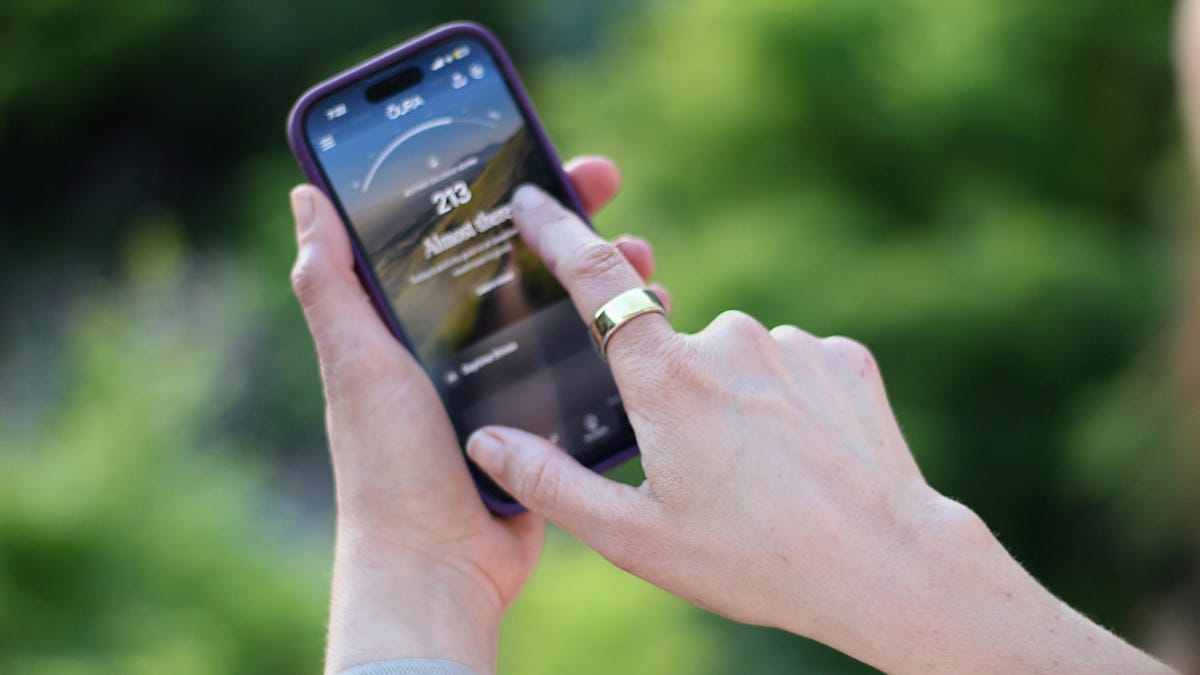
The Oura Ring has become synonymous with smart rings the way Kleenex has with tissues. With a 74% share of the category, according to Omdia’s November 2025 report, it’s helped define an entire category of health wearables.
As someone who’s spent months poring over my Oura Ring data, I thought I had a pretty good handle on what it could do. But after sitting down with Oura’s first-ever chief medical officer, Dr. Ricky Bloomfield, it turns out I was leaving a lot on the table.
Dr. Ricky Bloomfield, Oura Ring Chief Medical Officer.
A former physician and Apple Health executive, Bloomfield joined Oura in 2025 to help shape how the company’s data translates into real-world health insights. And the fact that he showed up to our interview wearing multiple Oura Rings proves he quite literally has his finger on the pulse of how tech is empowering health.
Our conversation led me to uncover tools I’d glossed over, learn the real story behind my favorite feature and rethink what’s possible when it comes to tracking your health from your finger. Spoiler: It goes well beyond catching a cold early.
Symptom radar: The best pivot to come out of the COVID-19 pandemic
One of my favorite Oura Ring features is Symptom Radar. At its core, it’s a sort of vitals dashboard that gives you a heads up when one of them drifts from your personal baseline, meaning it can give you an actual sign that your body may be under strain before you’ve fully registered it yourself.
“For many people, it’s like a check engine light on a car. Most of us aren’t experts in our cars — we might hear a funny sound, but seeing that light show up on the dashboard is confirmation that, ‘oh, we need to go do something about it,'” said Bloomfield.
My toxic trait is believing I can will illness out of existence by ignoring it, often powering through to the point of collapse. Symptom Radar has given me the objective confirmation I need to allow myself that rest day and will likely recover faster than if I’d just run myself into a wall.
Oura Ring’s Symptom Radar flags signs of strain on the body and suggests recovery days.
Symptom Radar’s beginning, however, was anything but linear. In 2020, at the height of the COVID-19 pandemic, Oura partnered with the University of California, San Francisco, on a study called TemPredict, which tested whether ring data and daily symptom surveys could predict COVID-19 before symptoms appeared, capturing its onset, progression and recovery.
It worked.
“What we found is that we could actually detect signs of COVID 2.75 days earlier than someone would otherwise find out with a COVID test,” said Bloomfield.
That’s the kind of lead time that could change behavior, potentially stopping people from spreading the disease and encouraging them to seek out treatment earlier.
But turning that into a consumer feature was complicated. Releasing a COVID-19-specific detection tool would have required a lengthy FDA de novo approval process (potentially spanning years) because nothing like it existed on the market at the time.
So they pivoted. Instead of a COVID detection feature, Oura released Symptom Radar as a wellness tool to flag deviations from your baseline vitals without pointing to a specific diagnosis. It was broad enough to avoid the regulatory hurdle, but useful enough to prompt action and a conversation with your doctor.
When the check engine light leads somewhere serious
What neither Oura nor its customers anticipated was how far that simple deviation alert would reach beyond cold and flu season.
“We’ve now seen multiple cases of lymphoma that have been found with this,” said Bloomfield. “All four cases of lymphoma were young women who were having vague symptoms.”
The ring didn’t detect lymphoma. But the repeated symptom radar notifications were the nudge the women needed to have a conversation with their doctor and seek a diagnosis for whatever was ailing them.
“In all of these cases, they probably would have gotten to that diagnosis eventually. But the important thing here is that time matters for something like lymphoma, a form of cancer, and the sooner you can get seen and evaluated for something like this, the better your chances to have a positive outcome,” said Bloomfield.
The Symptom Radar dashboard on the Oura Ring app breaks down the factors that contributed to a low Readiness score.
And it’s not just lymphoma. Similar patterns have played out with appendicitis, where repeated Symptom Radar alerts have prompted Oura Ring owners to seek care before their appendix ruptured (a serious complication if caught too late).
In other cases, the signals are less urgent but just as revealing. Some people have even noticed patterns in their data that tipped them off to a pregnancy before taking a test.
“Of course, we don’t have a feature that detects pregnancy, but they are observing the data themselves, and they’re able to draw these conclusions,” said Bloomfield.
Symptom Radar 2.0
Condition-specific alerts may be the next frontier for Oura, and the company is already laying the groundwork. Through Oura Labs (in the Oura app), ring owners can opt into a clinical study focused on detecting high blood pressure. This shift from broad signals to more specific, clinically validated insights could be a preview of what a more targeted version of Symptom Radar could become.
Unlike the current feature, though, this kind of detection crosses into regulated territory. “We’ve indicated publicly that our plan is to take that feature to the FDA once we’ve collected enough data,” said Bloomfield.
That’s the same path companies like Apple have taken with features like ECG and hypertension-related notifications. Oura is also running a women’s health study through Oura Labs, expanding its focus into areas like cycle tracking and reproductive health.
Why the finger may know more than the wrist
After years of testing wrist-based wearables, the idea of a ring tracking similar metrics from a smaller surface always gave me pause. In my mind: bigger sensor plus bigger surface area equals more information. Turns out bigger isn’t necessarily better, and position might matter more than size. According to Bloomfield, the finger is, in fact, the ideal spot for this kind of biometric data.
“You have two arteries that run along the bottom of your finger, actually, called digital arteries … which make it a better place to measure physiologic signals,” said Bloomfield.
The Oura Ring is comfortable enough to wear 24/7 and fades into the background, making consistent tracking easy.
The signal quality advantage is especially pronounced at night, which is precisely when the ring earns its keep. Wrist-based wearables can be too bulky to wear comfortably to bed, and many still need nightly charging. The ring is subtle enough to sleep with and, with a seven-day battery life, doesn’t need to come off to charge before bedtime.
“Because you’re not moving during sleep, you get a much more accurate signal. You also get more accurate temperature, which is important for a number of features, including our women’s health features, cycle tracking and fertile window prediction,” said Bloomfield.
Skin temperature fluctuates throughout the day as you move between indoors and outdoors and add and remove layers, like gloves. But at night in a more controlled setting, that data becomes reliable enough to act on.
Bloomfield also confirmed that using the ring only when sleeping is a legitimate strategy. You’ll miss things like daytime stress tracking, automatic activity detection and scores that require continuous wear, but you’ll still capture your most data-rich window.
The feature you’re actually sleeping on
Not one to leave potential health gains on the table, I asked Bloomfield which underutilized feature could have the biggest impact. His answer: cardiovascular age.
“We’ve had Oura employees who saw that the cardiovascular age was plus 5, plus 8. And that was the motivation they needed to start exercising,” he said. “Once you change your behavior, and you start exercising consistently, you will see that value starts to improve over time.”
Oura Ring’s cardiovascular age tool measures your heart health over time and translates it into how much younger or older it is compared to your actual age.
According to Bloomfield, the feature measures pulse wave velocity: the speed at which your pulse travels through your large arteries, including your aorta, carotid and femoral arteries. That speed is a proxy for arterial stiffness, which correlates with overall cardiovascular health. Stiffer arteries generally signal an older cardiovascular age. More elastic arteries mean the opposite.
I knew I’d seen it before but couldn’t locate it during our interview, which probably explains why people miss it. It lives under the My Health tab at the bottom of the app and requires data from at least 14 days (within the past 30) to unlock.
Turns out mine hovers between 8.5 and 10 years younger than my actual age, which was a pleasant surprise. But beyond the bragging rights, it’s a surprisingly accurate reflection of how active I’ve on a given week been and a useful reference point for tracking positive changes.
The long game
The broader vision Bloomfield described is a shift from reactive to proactive health care: a system where your ring helps you stave off illness and can flag something worth investigating before you’d have any reason to call your doctor.
“We’re moving from a health care system where we are seeing primarily reactive, sort of break/fix type care, into a world where we want to focus more on prevention and proactive care,” he said.
Making that vision accessible beyond people who can afford a $300 ring is something Oura is actively working on. The company has partnered with Essence Healthcare, a Medicare Advantage plan serving members in the Midwest, to provide the ring as a covered benefit at no cost to plan members.
“Insurance companies want their members to be healthier, which is one of those win-win situations. If members are healthier, there’s lower healthcare expense, and the member has the benefits of being healthier.”
The partnership expanded in 2026 after its first year — a sign that insurance-backed wearables may not be far off.
Watch this: Apple Watch vs. Oura Ring: The One Feature That Tipped the Scale
Read the full article here