


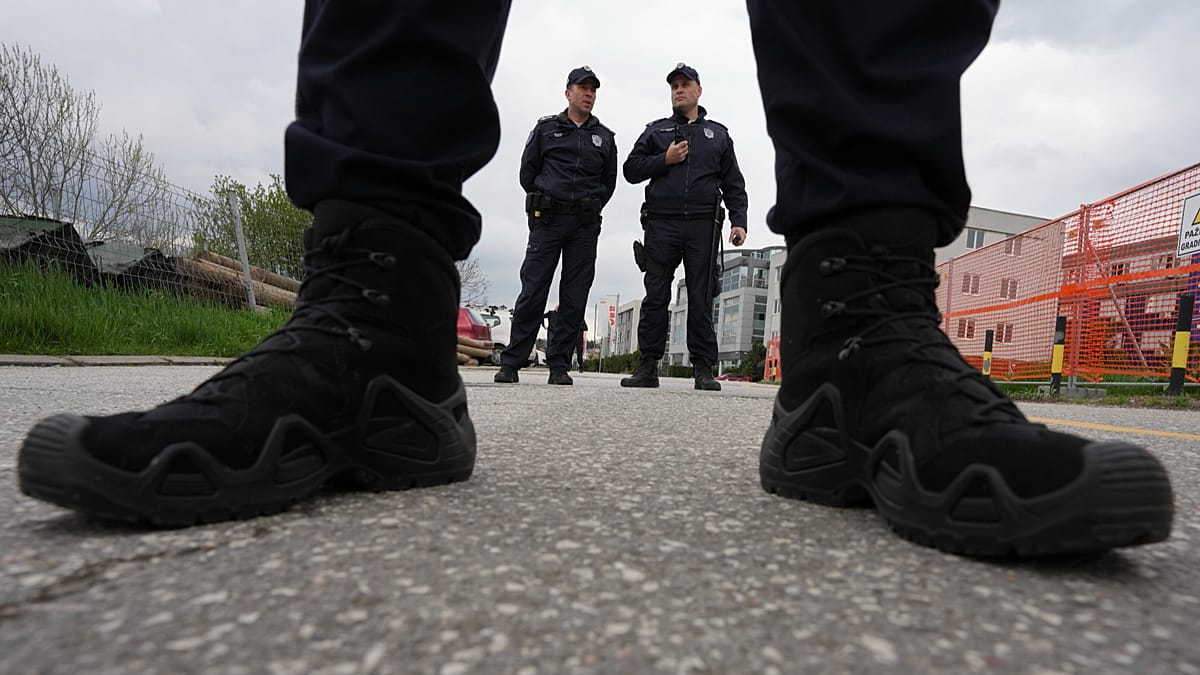
Belgrade is investigating the attempted sabotage of the pipeline transporting gas from Russia to Serbia and Hungary, according to officials, with a suspect said to be “a person from a group of migrants,” head of military security agency VBA Đuro Jovanić said.
The incident occurred on the Balkan Stream pipeline, an extension of the TurkStream pipeline. “Two large packages of explosives with detonators” were found inside backpacks in northern Serbia’s Kanjiža, “a few hundred metres from the gas pipeline”, Serbian President Aleksandar Vučić announced on Sunday morning.
Vučić also said he promptly warned Hungarian Prime Minister Viktor Orbán, who convened a security meeting that same day.
Jovanić said on Sunday that his agency previously informed the government that a “person from a group of migrants” with military training was plotting to sabotage the pipeline.
According to him, Serbian intelligence services had warned Belgrade “for months” that the gas infrastructure could be in danger and that a plot could result in its damage or destruction, but the services encountered “scepticism”.
The suspect “will be detained”, Jovanić said, and added that the investigation into the culprit or culprits might last days or months.
Jovanić also warned against a wave of disinformation involving Ukraine that was spreading online, noting that speculation has emerged that members of the Serbian army would work “for some other or third party by finding Ukrainian explosives and accusing the Ukrainians of organising the sabotage.”
“That’s not true. The Serbian army does not interfere in the politics of its own country, let alone any other,” the Serbian army intelligence chief added.
Meanwhile, Orbán implied Ukraine’s involvement without making a formal accusation. “Ukraine has been working for years to cut Europe off from Russian energy”, Orbán said in a video published on X on Sunday evening, saying that Hungary is reinforcing security around the pipeline.
Kyiv promptly replied, “categorically” rejecting the accusation. “Ukraine has nothing to do with this”, the foreign ministry spokesperson Heorhii Tykhyi said on X on Sunday.
Moscow meanwhile also pointed a finger at Ukraine, with Kremlin spokesperson Dmitry Peskov telling reporters on Monday that it is “high likely” that Kyiv is involved in this sabotage attempt.
Tensions between Hungary and Ukraine have been rising in recent months, with the integrity of critical infrastructure targeted since the beginning of Russia’s full-scale invasion in Ukraine in early 2022, and with Orbán facing an important election on Sunday.
The Soviet-era Druzhba pipeline, a separate pipeline that carries Russian oil to Hungary and Slovakia, has been the cause of a dispute between Hungary and Ukraine.
Kyiv has said the Druzhba was damaged in a Russian drone strike in late January and has yet to be repaired, but both Hungary and Slovakia accuse Ukraine of using the issue for political gain.
Kanjiža, a town of some 8,000 in Serbia’s northern province of Vojvodina, is mostly populated by the ethnic Hungarian minority.
During Europe’s migrant crisis in the mid-2010s, Kanjiža was a key transit point on the Balkan route, with improvised temporary camps set up near the town which have since been demolished.
Meanwhile, Orbán has been involved in a key electoral campaign at home against his main opponent Peter Magyar to win the vote on Sunday, yet he dismissed the Serbian pipeline plot as having anything to do with the election.
“I therefore recommend to everyone not to view this as a campaign issue. I see that it was not us who made a campaign out of this, but our opponents,” Orbán emphasised on Monday morning, stating that the country has reached a very critical period.
“The country’s energy security is not a campaign issue, it is a government issue, and that requires calm, strategic calm, not theater, not clowning, but a calm, steady, sure hand,” Orbán said in Kiskundorozsma, where he personally oversaw the reinforced military protection ordered the previous day for the Hungarian section of the Turkish Stream gas pipeline.
Vance on his way
Significant support for the current Hungarian premier had already come from the other side of the Atlantic, with US President Donald Trump endorsing Orbán — a key European ally of his — at the end of March in a video message, saying he was a “strong leader who fights for his country and his people”.
“He is a true friend, fighter, and winner,” Trump said. “He has my complete and total support.”
Meanwhile, US Vice President JD Vance confirmed he will arrive in Hungary on Tuesday to support Orbán, with his presence expected at an important Fidesz rally. The two leaders will also have a bilateral meeting.
This is not the first time a member of Trump’s administration backed a European party or politician facing an election.
In February 2025, Vance met far-right AfD party leader Alice Weidel during a visit to Munich on Friday, nine days before Germany’s election, but pointedly failed to meet with then-Chancellor Olaf Scholz.
During his visit he lectured European leaders about the state of democracy and said there is no place for “firewalls”.
The meeting with Weidel came after top German officials pushed back hard against Vance’s complaints about the state of democracy in Europe, following Vance’s remarks at the Munich Security Conference that he feared free speech was “in retreat” across the continent.
“To many of us on the other side of the Atlantic, it looks more and more like old entrenched interests hiding behind ugly Soviet-era words like misinformation and disinformation, who simply don’t like the idea that somebody with an alternative viewpoint might express a different opinion or, God forbid, vote a different way, or even worse, win an election,” Vance said.
Read the full article here