


Three deals across three key regions : Mercosur, India and Australia.
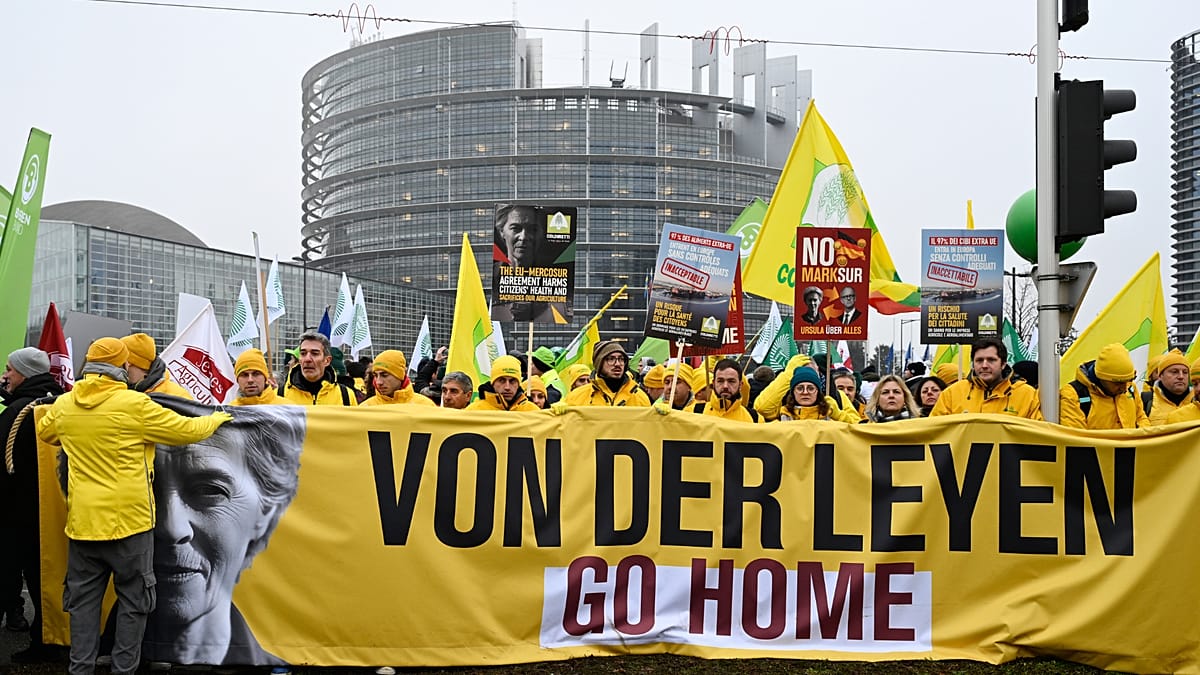
While the Commission hailed the Australia agreement as a new geostrategic win, EU farmers continue to express deep discontent stemming from the Mercosur deal.
In practice, the backlash around the agreement with Argentina, Brazil, Paraguay and Uruguay has done little to shift the Commission’s dual approach in its negotiating line. On the one hand, the commission kept making concessions on entry-level or mid-range farm goods such as beef, while on the other hand, it pushed for market access for high value-added exports —like wine, Geographical Indications (GI) and cars— with mixed results.
“The EU has all the assets to be an agri-food power,” Luc Vernet, from the export-focused brussels think tank Farm Europe, told Euronews, adding: “We should develop a broader strategy beyond high value-added products, covering all sectors and all levels of quality, because the European model delivers exceptional quality not just in luxury products.”
Yet the opposition to the Latin America deal — which triggered a legal challenge suspending its ratification — crystallised among EU farmers over fears of unfair competition from meat imports.
The Mercosur agreement granted quotas of 99,000 tonnes of beef per year, 25,000 tonnes of pork and 188,000 tonnes of poultry. Despite conditions added to new quotas in the Australia deal, EU farmers complain of imports piling up across successive agreements.
Concessions made on beef
Over eight years of talks with Canberra—the world’s second-largest beef exporter—Australia pushed hard for greater access for beef and sheep meat. Tensions intensified in 2023, when negotiations broke down after the EU rejected Australia’s demand for 40,000 tonnes of beef per year, offering no more than 30,000 tonnes instead.
The final deal agreed Tuesday allows 30,600 tonnes of beef annually into the EU. For sheep and goat meat, Brussels accepted a 25,000-tonne duty-free quota, while sugar was limited to 35,000 tonnes of raw cane for refining and rice to 8,500 tonnes a year.
However, perhaps drawing lessons from Mercosur, Brussels imposed multiple conditions on the quotas. Beef imports, which will have to be from grass-fed cattle, will be phased in over 10 years, sheep meat over 7 years, and rice over 5 years. Sugar will also be subject to certification under a private sustainability scheme.
Safeguard clauses, allowing both sides to react to market disruption, will apply for seven years – but are extended for sensitive farm goods : 15 years for beef, 12 for sheep and 10 for rice.
But a farmers’ representative told Euronews there were serious doubts about the effectiveness of the safeguard mechanisms: “Our experience in general with safeguards is that they are extremely difficult to activate because the burden of the proof is on us, farmers.”
The offensive agenda of the Commission
By contrast, agriculture was far less contentious in the India negotiations, where New Delhi itself resisted opening its market due to domestic farm sensitivities, particularly in dairy. EU sensitive products were largely excluded.
But wine featured prominently on Brussels’ offensive agenda, with Indian tariffs cut from 150% to 20% for premium wines and 30% for mid-range products over seven years. Tariffs for cars will also fall from 110% to 10% but under a quota of 250,000 vehicles a year after a decade – by which point Chinese manufacturers have great chances to have strengthened their position.
In negotiations with Australia, the EU again sought greater access for its wine but encountered strong opposition from domestic producers. In the end, the deal protects more than 1,600 EU wine GIs, plus over 50 new ones from 12 member states.
On Prosecco, Australian producers will still be allowed to use the term domestically to designate a grey grape variety, provided it is linked to Australian GI, with Canberra agreeing to stop exporting such wines after 10 years.
The EU also secured protection for 165 agri-food GIs and 231 spirit drink GIs. But it failed to remove Australia’s luxury car tax, securing instead preferential treatment for EU electric vehicles. But Brussels won improved access to critical raw materials – a key EU demand, that may have lead to more concessions on meat.
Read the full article here