Google’s new Pixel 11 Pro flagship phones have a lot to offer, so I put them to the test in France.
If you were hoping for a fully transformed Pixel 11 Pro, then prepare to be disappointed. Google’s latest flagship Android phone stays close to its predecessors, adding a variety of upgrades across the board — including a new home-made Tensor G6 processor, some new camera tricks and a glorious new peachy color. I’ve had my hands on the phone for the better part of a day, and while it’s not a revolution, it’s certainly one of the most accomplished phones Google has made.
And while I was expecting a significant price bump due to the ongoing components shortage, Google technically made its base model cheaper and more expensive. It depends on where you live.
Pixel Pro series pricing
| Model + storage | Storage | RAM | US | UK |
| Pixel 10 Pro | 128GB | 16GB | $999 | £999 |
| Pixel 10 Pro | 256GB | 16GB | $1,099 | £1,099 |
| Pixel 11 Pro | 256GB | 12GB | $1,099 | £1,079 |
| Pixel 10 Pro XL | 256GB | 16GB | $1,199 | £1,199 |
| Pixel 11 Pro XL | 256GB | 12GB | $1,199 | £1,279 |
Google eliminated the $999 128GB storage option from its Pro lineup, making the $1,099 Pixel 11 Pro with 256GB of storage the new barrier for entry. If you’re lucky enough to live in the UK, like me, 256GB of storage is now marginally more affordable with the Pixel 11 Pro starting at £1,079, £20 less than the 256GB Pixel 10 Pro. The Pixel 11 Pro XL is more expensive, starting at $1,299 in the US and £1,279, a $100 and £80 price increase, respectively, over the Pixel 10 Pro XL.
I was honestly expecting much worse. But RAM is another matter: All Pixel 11 Pro models start with 12GB of memory, compared to the Pixel 10 Pro and 10 Pro XL, which had 16GB. So while those UK prices might seem positive, it’s important to keep in mind that the starting RAM has dropped from 16GB to 12GB. If you want more, it’ll cost you. The Pixel 11 Pro and 11 Pro XL variants with 512GB and 1TB of storage come with 16GB of RAM.
But with seven years of software and security updates, the phones will still be good to use until at least 2033, as long as you look after them. The longer you keep using your phone, the more value you squeeze out of it.
As in previous generations, the only difference between the 6.3-inch Pixel 11 Pro and 6.8-inch 11 Pro XL is the screen size and a slightly bigger battery.
The Pixel 11 Pro and 11 Pro XL are now available to preorder, along with the Pixel 11, Pixel 11 Pro Fold and Pixel Watch 5. There is a Made By Google event tonight, Aug. 12, in New York, where we should learn even more about the new Pixel lineup.
I’ve not only been hands-on with the phone in Google’s Paris office, but I’ve also taken it on a lovely photowalk around the beautiful French capital, and there are a few things I like so far. So let’s dive in.
Pixel 11 Pro: Refined design with HiLight
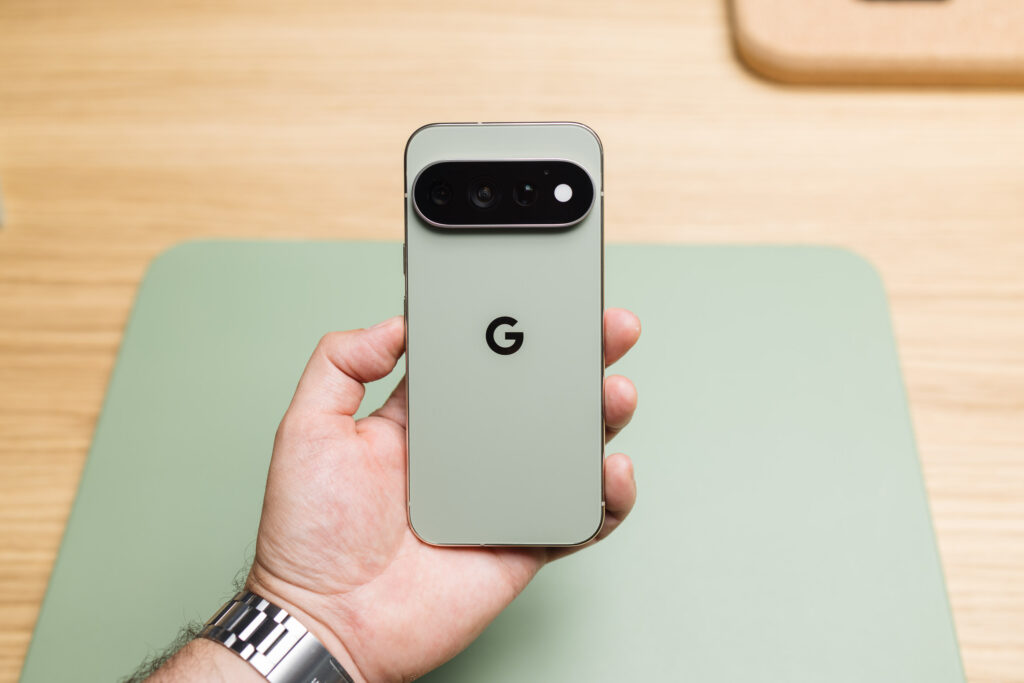
The Pixel 11 Pro and Pro XL’s look isn’t a significant departure from their predecessors, with a glass-and-metal construction and a pill-shaped camera bar stretching across the back. The glass on the bar now fills the whole “island camera block,” which looks classier as a result, while Corning Gorilla Glass Victus 2 apparently makes them the most durable Pixel phones yet. Great news for clumsy people — a group in which I count myself a proud member.

A new addition in the camera bar is the revamped LED flash, which serves a deeper purpose than simply lighting up your face in the dark. Google calls it HiLight, which now functions as a notification alert. If your phone is face down on your desk, the HiLight circle will light up to tell you of an incoming call or notification — or will glow to show that Gemini has been voice-activated and is listening to your commands.
It’s a neat idea, especially as you can customize the colors according to who’s getting in touch with you (a nice calming blue for your partner and an angry red for your boss, perhaps?) but it’s hardly a cutting-edge feature. We’ve seen notification lights on phones for years — most notably in the dazzling array of LEDs on the backs of Nothing’s phones — and while I’ve found them useful, I prefer keeping my phone screen-up so I can see the notifications for real.
The phone comes in a variety of new colors, including a nice sage green and a soft pink with gold accents, called canyon, that I absolutely love. I have a thing for pink gadgets (I even turned my orange iPhone 17 Pro pink with chemicals and customized my $8,000 Leica camera with a bright pink wrap) and I think these tones are the most beautiful Google has used on its phones. Don’t want the lovely pink? Fine, there’s also a matte black option, but just know I’ll be disappointed in you. Not angry, just disappointed.
Pixel 11 Pro cameras: New color profiles for creative shooters
While it might seem that the camera hardware hasn’t changed much since last year (it’s the same trio: wide, ultrawide and telephoto, all at the same resolutions), Google reckons a lot has been done to improve camera performance. For one, the main camera uses an “all-new” 50-megapixel image sensor that will apparently deliver better dynamic range and tones in a variety of conditions, despite being the same size as the 10 Pro’s 1/1.3-inch sensor.
The 48-megapixel telephoto zoom uses a larger sensor, promising a 30% increase in light capture.


I’ve taken a ton of photos around Paris using the Pixel 11 Pro XL and I’m impressed by what I’ve seen so far. Images are packed with detail, with evenly lit exposures that avoid looking too overprocessed. But to take my shots further, I also used the Pixel’s new Camera Looks tool, which offers a variety of color profiles designed to give your photos a more creative style than the default camera.
There’s a range to choose from — including a very high contrast black-and-white mode — and you can customize them further by tweaking the white balance, adding film grain and adjusting the intensity of the shadows. I really enjoyed playing around with these, especially the Vanilla look, which lends a warmer, almost filmic feel to the photos.


Some of the looks are too contrasty for my tastes but they’re nonetheless great fun to play around with and actually let you focus on the creative side of photography rather than it just being all about AI for a change. Don’t like the looks? You can also shoot in DNG raw and edit images to your heart’s content later on in apps like Snapseed or Adobe Lightroom.
But, yes, there’s plenty of AI going on in the cameras, too. Notably, the telephoto zoom can go up to 120x magnification, which gets you close to distant objects. Keep in mind that anything above 30x zoom uses generative AI to artificially recreate your image based on an assessment of the camera’s view. If you shoot your images in JPEG and raw you can see the wild difference between the pixellated photo of basically nothing your camera actually captured, versus the Gen AI version the phone created.

It actually works well. I took a photo of the French flag flying above a building, and it’s honestly wild that the phone could create a usable image. On the other hand, I personally don’t want generative AI anywhere near my photos. As a professional photographer myself, I want to know that what I captured was really there, not an algorithm’s approximation. So while I’m impressed at what this tech can do, I’m morally opposed to actually using it in my own work.
I feel much better about Google’s other new tool, called Magic Capture. This essentially shoots a short video clip and then uses AI to select the best still frames from it for you. It’s aimed at parents taking photos of their kids messing around and indeed I used it to snag some cool shots of a young skateboarder hitting a ramp in the heart of Paris. And I agree that the shots it selected were the best from the set.

I don’t mind this as it’s not using generative AI to create something that wasn’t there, it’s simply picking the best frames for you based on factors like which image is sharper, whether the whole person is in frame, if the subject has their eyes open and so on. Nothing is being altered, so you, the photographer, are still in control.
There are also new tools aimed at content creators, including an autocue mode that puts your script on-screen just below the front-facing camera, as well as the ability to group your videos into project folders for better organization. How helpful these tools really are for the creator community remains to be seen.
Pixel 11 Pro: Android 17 and AI additions
The phone launches with the latest Android 17, and as it’s a Google phone, there’s no additional manufacturer skin on top (like Samsung’s OneUI, for example). So you get a neat, fuss-free experience. It’s why the Pixels are among my favorite Android phones for everyday use.

There are some new AI tools thrown in, too, including deeper functionality for Gemini Intelligence to surface relevant information automatically as you go about your day (such as bringing up flight info when messaging your friend about your travel plans). Circle to Search also works within the camera for live translation and search. For example, if you circled a menu item in Japanese, it could not only translate that to English but also provide more information about the dish itself.
Speaking of translation, the phone can also translate and provide real-time dubbing for certain videos and apps. My colleague, CNET senior technology reporter, got to test the Pixel 11 Pro’s translation/dubbing feature as well as one that translates American Sign Language, and she was floored. This is likely to include YouTube, but we’ll find out more when the Pixels launch. This sounds like a genuinely useful tool, though how it really works — and how accurately — remains to be seen when we can put the phones to the test.
Pixel 11 Pro: Should you buy it?
Google certainly hasn’t overhauled its formula for its Pixel phones this time around. The 11 Pro models are best seen as iterative upgrades over the previous generation, but given how good the Pixel 10 Pro was — and the fact that price has effectively remained the same — that isn’t such a bad thing.

There are enough tweaks in the design to help it feel fresh enough, especially that soft pink color. And the new Camera Looks for your photos, the HiLight notifications alert and the new AI tools feel like they could be genuinely useful additions. Throw in the faster charging speeds (Google promises 75% in 30 mins) and the new Pixel 11 Pro range seems to have a lot to offer.
My camera test in Paris has shown me that it’s well equipped for at least casual photographers, but I’ll look forward to getting a unit in my hands for the full review later this month.
Read the full article here