These Cookies Are 3D-Printed and Made of Recycled Plastic

News Room
5 Min Read

Would you eat a cookie made from an upcycled water bottle? One group of scientists thinks that at least some people will in the near future. They’ve genetically engineered yeast to transform PET plastic and agricultural waste into a vanilla-flavored protein cookie that they think could be a solution to both plastic pollution and food shortages. Sounds delicious.

The project began as part of NASA’s Deep Space Food Challenge — one of the agency’s Centennial Challenges — in which scientists and researchers were tasked with developing new technologies and approaches for the problem of feeding astronauts on long space voyages. For microbiologists at Southern Illinois University Carbondale, the solution lay in converting plastic and plant waste into “edible, protein-rich supplements.”

Their concoction — snack-sized morsels called “µBites” (pronounced “microbites”) — didn’t end up winning the Deep Space Food Challenge. The grand prize went to Interstellar Lab of Merritt Island, Florida, and its autonomous, environment-controlled greenhouses that generate fresh vegetables, microgreens and insects (yes, insects) necessary for micronutrients. However, NASA pushed the team to keep working to bring its plastic-derived cookie to reality.

On Monday, at the American Chemical Society Expo in Chicago, the SIU Carbondale team, led by associate professor Lahiru Jayakody, presented new enhancements to the flavor, aroma and color of the cookies.

The process starts with one of the most common forms of single-use plastic, polyethylene terephthalate, or PET — what most single-use water and soda bottles are made of — which is mixed with plant waste biomass such as corn stalks and leaves. Hot, high-pressure water and oxygen break the mixture down into carbon-rich molecules, which are then fed to a mix of genetically reprogrammed, safe-to-eat yeast strains. 

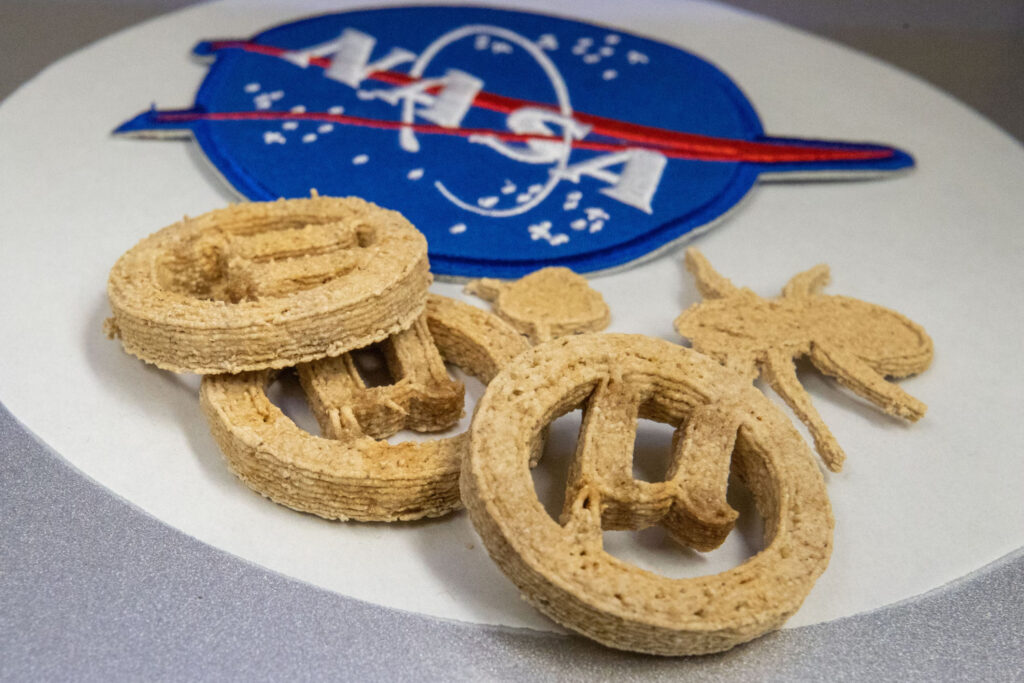
Lahiru Jayakody, who led the project, holds one of the 3D-printed, plastic-derived cookies.Rusty Bailey/SIUC Media & Communication Resources

The feasting yeast converts plastics and agricultural waste into proteins, fats and flavor. An engineered strain of Saccharomyces cerevisiae converts ferulic acid to vanillin, the compound responsible for vanilla flavor and aroma, while a modified strain of Rhodosporidium toruloides produces beta-carotene, a source of vitamin A. This result is further mixed with fiber, starch and sweetener to create an edible “slurry” that is passed through a 3D printer to form a familiar cookie disc, complete with the Greek letter “µ” branding.

At this point, the cookie is theoretically ready to eat. However, Jayakody told The Guardian that the team hasn’t yet actually tasted the cookies and is still “awaiting approval for testing on humans,” but that they “receive high marks on aroma.”

Though the project began as a moonshot food supply for long-distance space travel and disaster zones, Jayakody and team believe the concept could eventually find its legs as a “promising solution to address both food shortage and plastic pollution simultaneously.”

“Global food demand is expected to rise 35–56% by the year 2050, and about 30% of the world population will be at risk of hunger in the future,” Jayakody said in a statement. “The way to address that, I believe, is by using microbes.”

At this early stage, these cookies are also very expensive. Costing around $60 per kilogram (2.2 pounds) to produce, they’re far from an economical solution to world hunger. However, the SIU Carbondale researchers believe they can improve the yeast’s efficiency and, with scale, reduce costs. 

Personally, my curiosity is piqued; I want to know what they taste like. (I’m a fairly adventurous eater.) Convincing the public to accept and eat plastic-derived cookies made from trash, on the other hand, is a challenge that may take more than science to solve.

Read the full article here

Share This Article
Leave a comment

Leave a Reply

Your email address will not be published. Required fields are marked *