


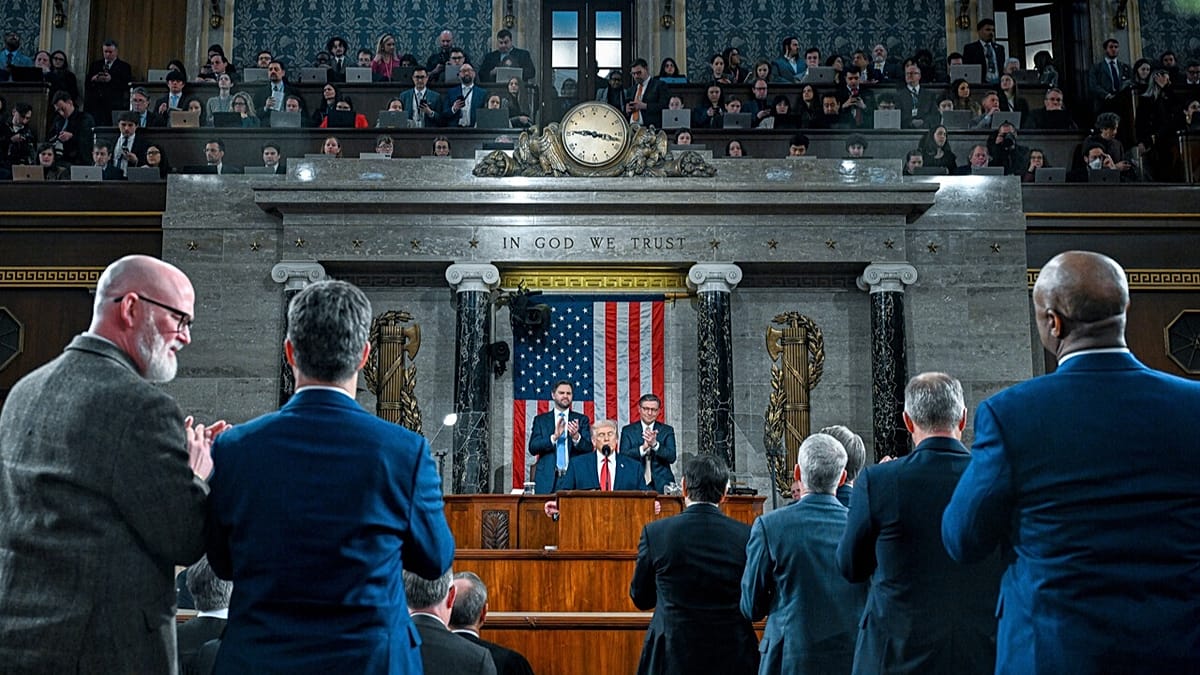
US President Donald Trump beat his own record on Tuesday, delivering the longest-ever State of the Union address, clocking in at just under 1 hour and 48 minutes.
Traditionally, the speech before Congress largely focuses on domestic politics, offering a state of play on the US economy and internal affairs, and that was mostly the case in Trump’s latest speech.
It came shortly after the Supreme Court struck down his signature global tariffs, with growing indications of potential new US military strikes on Iran and as Trump’s favourability ratings at the lowest point they’ve ever been in either of his two terms.
While there was little mention of Europe itself, Trump dedicated attention to his defence of tariffs, and boasted of his efforts to end global conflicts including in Ukraine and Gaza, all while outlining a rationale to launch a major military strike against Iran.
Here are three things Europe should take away.
Looking to the midterms
With much of the nation worried about the direction of the economy and Trump’s approval ratings in decline, Tuesday’s speech offered a glimpse into what to expect from the upcoming midterm elections in November.
Trump presented a rosy picture, claiming the economy “is roaring like never before,” as he cheered the lower cost of gasoline, mortgage rates, prescription drug prices and the rising stock market: “Millions and millions of Americans are all gaining.”
But with many Americans feeling economic strains, that boast of optimism risks making Trump sound out of touch. According to AP-NORC polling, just 39% of US adults approved of Trump’s handling of the economy in February.
The mood in the room also reflected the deep political divide in America. Trump took aim at Democrats and blamed them for many of the nation’s ills, seeming to get angrier as the speech progressed.
“These people are crazy, I’m telling you, they’re crazy,” he said. “Democrats are destroying this country.”
Congress plays a key, performative role during the State of the Union, applauding and standing up in agreement with the president or sitting still to voice their displeasure.
Notably, Trump urged lawmakers to pass the so-called SAVE America Act, which would require proof of citizenship to vote, something he has pushed for based on unsubstantiated claims of voter fraud. False theories about illegal foreign voters are among the claims he has used to justify his 2020 election loss, and he could resort to similar ideas to cast doubt on this year’s outcome if Republicans lose their majorities in the House of Representatives and Senate.
Dozens of Democrats skipped the event altogether, and those in attendance largely stayed seated except on rare occasion.
Tensions soared when House Democrat Ilhan Omar, who has frequently sparred with Trump, shouted at the president while he spoke.
“You have killed Americans,” Omar shouted in response, in reference to the deaths of two protesters at the hands of federal agents dispatched to Minneapolis last month.
The lawmaker, into whose district Minneapolis falls, left the House chamber before Trump had finished his speech.
The outcome of November’s midterms could have critical implications for the success of Trump’s policies, including foreign policy in the second half of his second term, and the Democrats have a good chance at success in flipping the handful of seats needed to take control of the House in November.
Indifference towards Supreme Court tariffs ruling
Trump notably held his tongue when it came to the Supreme Court’s decision to strike down his global tariff policy last week, toning down previous attacks on the US judicial body.
Last week, Trump said the justices who voted against the tariffs were an “embarrassment to their families.” But on Tuesday, he simply called the ruling “unfortunate”.
At the same time, he defended his overall tariff policy – and his decision to raise global tariffs from 10 to 15% in the wake of the Supreme Court Ruling.
“The good news is almost all countries and corporations want to keep the deal that they already made,” Trump said. “The legal power that I as president have to make a new deal could be far worse for them and therefore they will continue to work along the same successful path we had negotiated before the Supreme Court’s unfortunate involvement,” he added.
Posting on social media on Monday, Trump threatened countries around the world to abide by any tariff deals they have already agreed to.
Any country that wants to “play games” with the Supreme Court decision, Trump wrote, will be met with “a much higher tariff, and worse, than that which they just recently agreed to.”
Foreign policy in the background
Trump’s State of the Union was heavy on domestic issues, but he also made the case for his foreign policy efforts to Americans who are increasingly uneasy about his priorities.
The president cheered the brokering of a fragile ceasefire deal in Gaza and his team’s bringing home hostages taken by Hamas militants, the capturing of autocratic leader Nicolás Maduro in Venezuela, and pressing fellow NATO members to increase defence spending among his biggest wins.
But apart from a brief victory lap on his achievements, Trump had little to say about his European allies, or the crisis that shook the decades-long security of the transatlantic NATO alliance when he refused to rule out military force to take control of Greenland earlier this year.
The omissions signal that Trump needs to fight back against a growing scepticism that he’s staying true to his “America First” philosophy after a year in which his focus was often far from home.
In surveys from The Associated Press-NORC Center for Public Affairs Research conducted earlier this month and in January, a full 61% of US adults said they disapprove of how Trump is handling foreign policy, while 56% say Trump has “gone too far” in using the US military to intervene in other countries.
Nevertheless, Trump continued with his strong language against Iran, outlining a rationale to launch a new major military strike against the country. Notably, he warned that the nation has developed missiles that can threaten Europe and is working on missiles “that will soon reach” the US.
“My preference is to solve this problem through diplomacy. But one thing is certain, I will never allow the world’s number one sponsor of terror, which they are, by far to have a nuclear weapon,” he said. “Can’t let that happen.”
Read the full article here