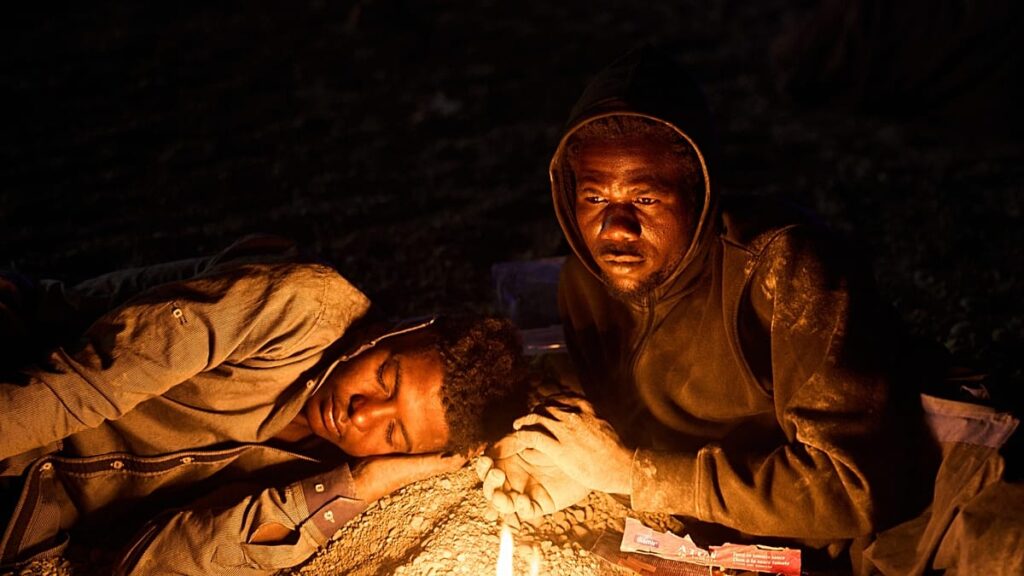
Thousands of illlegal migrants who arrived Ceuta late-July are still in the autonomous Spanish enclave while reception facilities struggle to cope with an emergency that has overwhelmed their capacity.
Many migrants are sleeping in the open on the streets, with residents handing out food and NGO and associations cooking non-stop for almost two weeks.
The situation is one of “complete vulnerability”, Halima Ahmed, spokesperson and social educator for Ceuta-based NGO Luna Blanca, tells ‘Euronews’.
There are people who eat only once a day and rely on humanitarian organisations or even on neighbours cooking food in their own homes. On its first day of response, Luna Blanca distributed 3,500 food containers and since then has continued cooking every day with the help of volunteers and donations.
Within the crisis,one particularly vulnerable group is being mentioned: children.
Among those still outside the reception system are boys and girls who have yet to enter the child protection scheme. Some of them, according to organisations working in Ceuta, remain in hiding because they are afraid to go to the centres set up by the authorities.
Knowing how many there are is part of the problem.
Around 1,500 unaccompanied minors have already been identified and are within the protection system, but Save the Children estimates that more than 4,000 are still unidentified in Ceuta.
Some are hiding or remain beyond the reach of child protection services, while reception facilities are overwhelmed.
Their situation has sparked worry and another crisis, this time a political one: the question of what to do with them hangs over the Spanish government.
While Ceuta insists it does not have the capacity to take them in on its own, the transfer of minors to the Spanish mainland is dividing Spain’s autonomous communities, and the possible return of some to Morocco raises questions about the safeguards that must accompany any repatriation.
At the same time, NGOs trying to meet the most immediate needs are also facing accusations of going beyond humanitarian assistance and supposedly helping migrants leave Ceuta irregularly for the mainland. ‘Euronews’ has spoken to five organisations to map out a crisis where humanitarian emergency, child protection, the debate over sharing responsibility and the limits of aid all intersect.
Children at risk of violence, trafficking and exploitation
Precariousness hits particularly hard for those who crossed the border alone. “Every night a boy or a girl spends on the street exposes them to serious dangers, from a risk of violence, trafficking or exploitation to psychosocial or even health risks”, warns Catalina Perazzo, Director of Advocacy and Territorial Development at Save the Children.
The organisation says that, through other groups working on the ground, it has received accounts of violence and sexual assault, although it notes that it has not dealt with these cases directly.
The problem does not affect only those who remain on the streets. Facilities opened for those already inside the protection system are also stretched to the limit. “With the resources the autonomous city has, with the reception centres and the means they have, it is impossible for them to uphold the rights of children and adolescents”, says Perazzo.
Unicef shares that assessment. The agency says many minors are still on the streets and that protection centres are “totally saturated”. Its immediate priority is to know how many there are, who they are and where they are. “Right now not all children in Ceuta are protected, they are not safe; they are in a situation of neglect,” José María Vera, executive director of Unicef Spain, tells ‘Euronews’.
The Spanish Commission for Refugee Aid (CEAR) also warns that minors who have not yet been identified cannot fully access the protection system or care tailored to their needs, including psychological support or legal advice. “They are in situations of abandonment”, says Verónica Laorden, national head of CEAR’s Advocacy, Research and Studies Service.
Organisations agree that the urgent priority is to locate, identify and protect all minors. But with reception resources at breaking point, another question immediately arises: if Ceuta cannot cope on its own, who should?
The controversial question of relocation: mainland or Morocco?
While some autonomous communities have expressed reluctance to take in unaccompanied minors, the organisations consulted by ‘Euronews’ argue, with varying nuances, that Ceuta cannot handle the situation alone.
For Amnesty International, the debate cannot be reduced to which regions are willing – or not – to receive minors. “The state must ensure the best interests of the child, and that best interest of the child takes precedence over other statuses, such as migration status,” says Amnesty International researcher Dani Canales.
Save the Children likewise believes it is necessary to speed up the transfer of minors to the mainland, where they can be taken in while the best solution for each child is assessed individually. The organisation calls for shared responsibility between Spain’s regions and reminds that managing migration flows also requires a joint response at European level.
But transfer to the mainland does not have to be permanent. Also on the table is family reunification in Morocco. Unicef, Save the Children, CEAR and Amnesty all agree that any decision must be taken on a case-by-case basis, according to the best interests of the child.
Before any return, organisations insist on checking whether the child needs international protection, listening to their wishes, locating their family and determining whether this really is a safe environment. “There can be no mass returns”, says Laorden.
Save the Children also points out that the two options are not mutually exclusive: a child can be temporarily moved to another region while the authorities assess whether later family reunification in Morocco is the right solution.
When help arrives before the authorities
While institutions decide how to reorganise reception, much of the immediate response has fallen to organisations and local residents. But NGOs warn they cannot permanently replace the state.
“Humanitarian assistance cannot rest solely on organisations”, says Laorden. For CEAR, once the initial days of emergency are over, it is up to the state to guarantee care and rights for those left without support.
This is where one of the paradoxes of the crisis appears: some organisations say they have staff and resources to act, but do not always have the legal powers to intervene on their own.
Save the Children says it has offered its services both to the autonomous city and to the central government, but child protection is a public responsibility and the organisation needs authorisation for certain interventions. “Our only frustration is that we need to be given permission to do it”, explains Perazzo.
The battle against disinformation
Meanwhile, accusations have circulated on social media, claiming that certain humanitarian organisations are helping migrants leave Ceuta irregularly for the mainland. These include unverified messages and images linked to people carrying Red Cross bags on a ferry.
‘Euronews’ explicitly asked the organisations interviewed whether they knew of cases in which NGOs had irregularly facilitated such transfers. None of the sources consulted provided any cases that would support that accusation.
The Red Cross declined an interview with ‘Euronews’, but denied the allegations in comments to ‘RTVE Verifica’ .
Amnesty International says it has also tracked other episodes of disinformation linked to the crisis, including images of disturbances presented as recent and as having taken place in Ceuta which, according to the organisation, did not match either the location or the time claimed.
For Canales, disinformation ends up pushing aside debate about an emergency in which people still need assistance and protection.
“It diverts the discussion elsewhere and does so on the basis of false information in order, in some way, to instrumentalise certain messages”, he says.
Amnesty sees signs of possible rights violations
In the meantime, Amnesty International continues to gather information about the conduct of the Spanish authorities during the crisis and has raised its concerns with the Interior Minister and the government’s delegate in Ceuta. Among them is the possibility that returns may have taken place without the necessary safeguards.
Canales stresses that the investigation remains open and avoids presenting the possible violations reported to them as established facts. However, he says the evidence gathered so far suggests, “at this preliminary stage”, that there may have been human rights violations and “summary and unlawful returns”.
The issue has taken on particular importance after Spain and Morocco agreed to step up coordination in order to repatriate “as soon as possible” people who entered Ceuta irregularly. The agreement was confirmed both by Spain’s Interior Ministry and by official Moroccan sources.
The criticism is not directed solely at Spain. Moroccan civil society organisations have also condemned the political use of migration by Rabat and demanded accountability for the situation driving thousands of young people to try to leave the country.
For Amnesty, what has happened in Ceuta cannot be viewed in isolation. The organisation places the crisis within a broader problem of European migration policy which, in its view, has prioritised “closing borders” over establishing “safe and legal routes for migration” and for seeking asylum.
According to Amnesty, the lack of legal alternatives is pushing some people towards increasingly dangerous routes. The organisation insists that any return, regardless of how people arrived, must respect the safeguards required under international law and allow possible vulnerabilities or needs for international protection to be identified.
CEAR also stresses that the urgency of the situation cannot justify diluting legal safeguards. “We cannot play games with human rights”, says Verónica Laorden.
A city torn between solidarity and exhaustion
Almost two weeks on, Luna Blanca also describes Ceuta as a city on its knees. Ahmed talks of overwhelmed neighbourhoods, dirt and a growing sense of insecurity among some residents, but rejects the idea that this frustration should be used to criminalise all those who have arrived.
“This is not about criminalising people. They are not numbers, they are people”, she says.
As the debate continues over how many minors should be moved, where they should be housed and who should take responsibility for their protection, the organisations interviewed agree that there is still one unresolved question for all of them: knowing who they are, where they are and ensuring they are safe.
Read the full article here