


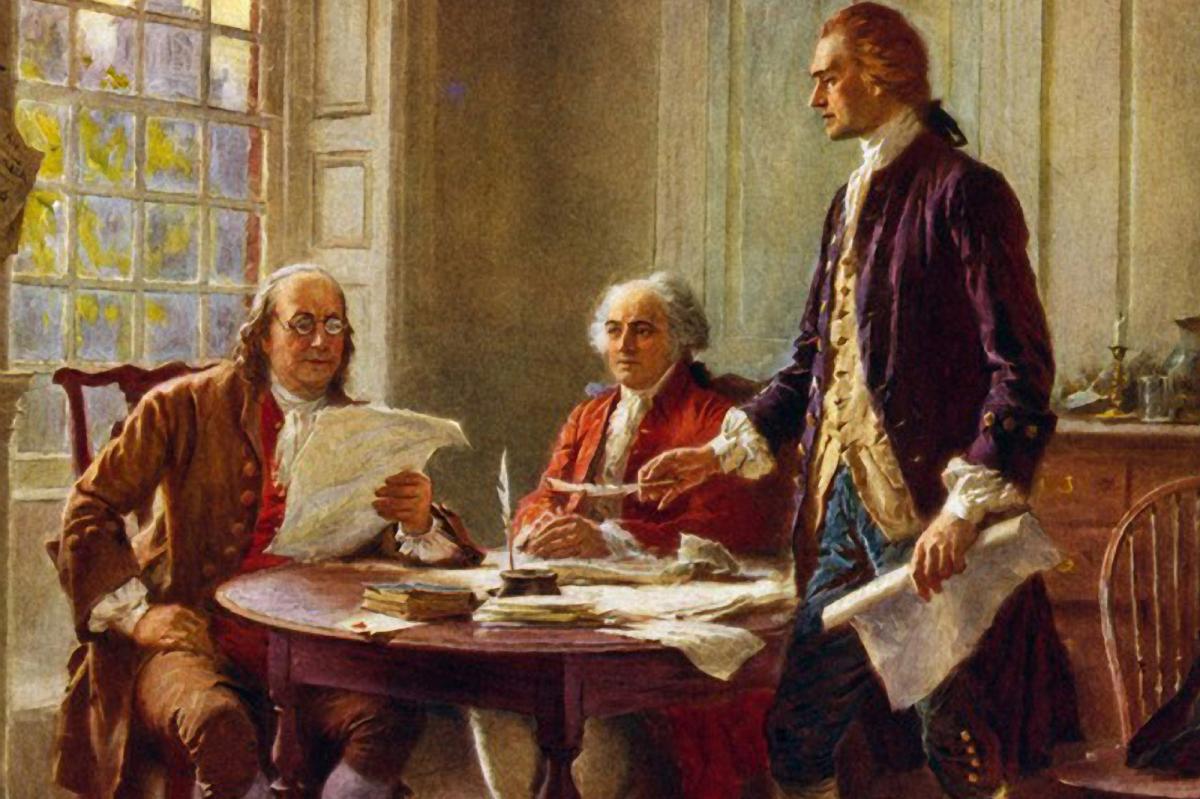
The primary obligation of any government, the Declaration of Independence tells us in its famous second paragraph, is the “safety and happiness” of its citizens. The necessity of securing safety is obvious (except to progressive politicians in big blue cities, who are often diffident about crime and disorder), but it is thought something of a novelty of the Declaration to set out “the pursuit of happiness” as one of the central “inalienable rights,” along with life and liberty.
It is well established that Thomas Jefferson and his collaborators in writing the Declaration (John Adams, Benjamin Franklin, Roger Sherman and Robert Livingston) followed the language and logic of John Locke’s “Second Treatise of Government.” But Locke and other social-contract theorists of the era typically spoke of the inalienable natural rights to “life, liberty and property,” or “life, liberty and estate.” Why this change, and how should it be understood?
This innovation did not originate with Jefferson or the Declaration.
The swap of “happiness” for “property” can be found in a number of formal political documents and even in the Sunday sermons of clergy at the time. Historian Pauline Maier’s magisterial “American Scripture: Making the Declaration of Independence” (1997) observes that “references to happiness as a political goal are everywhere in American political writings as well, as anyone can see who bothers to look.”
The phrase appears in eight of the early state constitutions, for example.
Maier is among the many historians who take note of George Mason’s first draft of the Virginia Declaration of Rights, written in May 1776, which proclaimed that the inalienable rights of man include “the enjoyment of life and liberty, with the means of acquiring and possessing property, and pursuing and obtaining happiness and safety.”
Here, property is seen as an important means rather than an end in itself. Maier thought that Jefferson was merely being more economical than Mason, “sacrificing clarity of meaning for grace of language.”
But was it merely a rhetorical gimmick? The question of how the “pursuit of happiness” was understood in 1776, and how it’s fit into the larger American story ever since, is a fitting question to visit on the Declaration’s 250th anniversary.
“Happiness” is certainly a more capacious term than “property,” and what is more American than the pursuit of happiness, especially since it is typically thought of in highly individualist and materialist terms, which is to be expected in a commercial republic? The cornerstone of “the American Dream” is owning your own home or small business that enables more individual freedom.
And so the Declaration’s inclusion of the pursuit of happiness is regarded as a significant milestone in liberal individualism, with maximum autonomy to define for yourself whatever purposes or means will make you happy.
Today, “happiness studies” is becoming a full-fledged profession and academic field, and happiness is equated with “self-fulfillment.” What we call the classical-liberal tradition of the 18th century did represent a shift toward a “privatization” of happiness, in which achieving happiness was left to the individual rather than guaranteed by the community.
That is why the Declaration says “pursuit” of happiness, rather than a guarantee of happiness, just as the preamble to the Constitution says government should “promote” the general welfare rather than provide the general welfare.
This shift can be observed in a subtle revision of Pennsylvania’s state bill of rights in 1790, which changed a right of “obtaining happiness” to “pursuing their own happiness.”
But by degrees in the 20th century, the liberal-individualist understanding of the pursuit of happiness has become hard to distinguish from mere willful hedonism, with the popular understanding expressed in the clichés “Whatever floats your boat” and the more direct “If it feels good, do it” — practically the central mantra of the 1960s sexual revolution.
Of course, Jefferson indulged some spectacular sins of the flesh (as did Alexander Hamilton, Ben Franklin, Gouverneur Morris — you get the idea) as was well known at the time.
But did Jefferson and the other founders mean for the “pursuit of happiness” to be understood hedonistically? And was it meant to replace or downgrade the place of property as a fundamental right, which the radical left much desires? Keep in mind the radical left has always hated the pro-capitalist American Constitution because it believes, in Proudhon’s famous phrase, that “property is theft.”
While Jefferson and many of his compatriots fell short of the highest standards of private virtue, there is no doubt the leading founders all understood and cherished the connection between virtue and happiness derived from both the classical and Christian traditions.
One of the most succinct summaries of this view came from George Washington, who remarked in 1789 that “there exists in the economy and course of nature an indissoluble union between virtue and happiness.”
Douglass Adair, a criminally neglected historian from two generations ago (d. 1968), argued boldly in “The Intellectual Origins of Jeffersonian Democracy” that Jefferson owed his ideas on happiness and virtue to Aristotle, in particular Aristotle’s “Nicomachean Ethics.”
Adair may overstate the case, but Jefferson did say in an 1825 letter to Richard Henry Lee that the inspiration for the Declaration owed to “the elementary books of public right, as Aristotle, Cicero, Locke, Sidney, etc.” — a seemingly unusual pairing of two ancient authors and two modern.
Certainly, classical Greek and Roman influences on the founders’ political philosophy and practical politics is undeniable. Just think of the Roman pseudonym “Publius” the three authors of “The Federalist Papers” chose.
Carli N. Conklin, professor of law at the University of Missouri, offers another thorough treatment of this question in her recent book “The Pursuit of Happiness in the Founding Era: An Intellectual History” (2019).
Conklin brings out especially the influence of British jurist William Blackstone. Blackstone follows Aristotle in understanding the realization of happiness to necessarily involve the individual’s harmony with natural law.
The classical understanding of virtue and happiness is as distant as possible from today’s “anything goes” attitude in which happiness is completely idiosyncratic to every individual. The classical conception connects to a substantive and detailed idea of what makes for the highest human happiness. The ancient Greek term telos — “end,” “goal” or ultimate purpose of human life — was easily incorporated by Christianity, and the Bible was equally an authoritative influence on the thought of Blackstone and the founders.
Here, the story gets tangled. Blackstone didn’t much care for Locke, and Jefferson didn’t much care for Blackstone, and Blackstone’s omission from Jefferson’s explanations of the Declaration means his influence requires some effort to detect. Conklin does this well and presents one of the most effective rebuttals to the many historians who think “the pursuit of happiness” is mere rhetoric or a “glittering generality” without much substance.
Equally defective is the idea especially beloved of progressive historians and political scientists for more than a century that the shift from “property” to “happiness” represented a major change from the Lockean elevation of property rights.
A hundred years ago, Vernon Parrington wrote in his influential “Main Currents in American Thought” (1927) that Jefferson’s swap was a “revolutionary shift” and a “complete break” that was “singularly fortunate for America” because it opened the door to socialism (though he doesn’t say this directly).
This and similar left-leaning interpretations are ahistorical, as Edward J. Erler explains in detail in “Property and the Pursuit of Happiness” (2019).
To the contrary, Erler assembles evidence from numerous leading thinkers of the founding era that property was considered a necessary condition for the pursuit of happiness.
James Madison perhaps put it best in his essay “On Property,” which connects property rights with every other fundamental right such as freedom of speech and freedom of religion. His argument culminates with: “As a man is said to have a right to his property, he may be equally said to have a property in his rights.”
But the final indication that “happiness” in the Declaration cannot mean simply maximizing pleasure or material acquisition alone comes from considering the document’s ending. There the signers “mutually pledge to each other our Lives, our Fortunes, and our sacred Honor.”
Recognize that this means the signers were willing to yield their material fortunes and even their lives — the first “inalienable right” listed at the Declaration’s beginning — in service of the one thing that cannot be taken from them: their honor, which is higher in rank than life itself.
That is a high kind of happiness indeed and very much worth recovering today.
Steven F. Hayward is visiting professor at Pepperdine University’s School of Public Policy.
Read the full article here