


 Jacob Wackerhausen/Getty Images
From comparing the best internet providers in your area to understanding your actual speed needs, we’ve spent years here at CNET covering the best ways to lower the cost of home internet. But how did our internet bills get so high in the first place?
It wasn’t an accident, that’s for sure. According to a recent CNET survey, over 63% of adults in the US saw their internet prices increase year over year. That’s what happens when the wide majority of plans come with a flashy promotional rate packed with fine print designed to balloon your bill in the long run.
Internet service providers don’t always make it easy to avoid unpleasant billing surprises like those, but we can help. Keep reading for a full guide to common home internet pricing traps and the best ways to shield your budget from them.
This article was made possible in part by Xfinity. It was written and edited independently without partner oversight.
So… your internet bill doubled
Most of us have moved into a new home and needed to set up a fresh internet connection. Here’s how it usually goes: You try signing up online, but after a few clicks, you’re directed to give the company a call instead. So, you hop on the phone with a plan in mind, but pretty soon, the customer service representative starts selling you on a faster plan.
The pitch sounds pretty good – zippy speeds, maybe a free streaming subscription or two to go with them and, to top it all off, a discounted promotional rate on your monthly bill. You decide to go for it. Boom, your home internet is taken care of, your speeds are nice and fast, and you think you scored a sweet deal in the process. Wrong.
A year passes, and you notice your monthly bill has doubled in price. Sound familiar?
You call your internet provider, and the voice on the other end explains that your price increased because your promotional rate expired. So now, you’ll be paying a higher rate. Oh, and remember those free streaming services that were bundled in? Those were only included during the promotional period. At this point, the customer service rep might even try to offer you another promotional plan – for one year – followed by yet another, even bigger price increase.
That’s just one example of a common home internet pricing trap, and it’s the kind of thing that causes people to pay far more than they need to for their home internet service. The good news is that you don’t have to fall for schemes like these. You just have to know how to spot them.
 Feodora Chiosea/Getty images
What are pricing traps?
Pricing traps are essentially tactics businesses use to lure customers into paying more for something. For instance, your ISP will happily talk you into paying more for a faster plan with speeds your home doesn’t always need. Others will insist that the best value only comes once you’ve bundled your home internet with a mobile or TV package you might not have been interested in to begin with. In either case, the end result is that you’re paying more than you probably would have if you had never talked to a salesperson at all.
Promotional rates are a favorite of the ISP industry, and they’re also the most common home internet pricing trap. Those rates look tempting at a glance, but they amount to little more than mousetrap cheese if the promotional period is short. Once that promo period ends, the trap is sprung, and you’re stuck paying more.
Here are all of the most common techniques that ISPs use to lure you into paying more:
The most common internet pricing traps
| The trap | How to avoid it | |
| Promotional pricing | Your provider lures you in with a discounted rate for the first year. After year one, your bill shoots up. | Consider multiyear price lock offers that cost less in the long run. If none are available, be sure to do the math on the full cost of any contract before signing it |
| Perks and freebies | The provider offers free devices, streaming subscriptions, or gift cards to lure you into signing up for an expensive plan with speeds you don’t actually need | Understand how much speed your home actually needs before signing up. Don’t upgrade to a faster plan just because the incentives are tempting |
| Terms of service & hidden fees | Sometimes, the ISP will tuck away additional costs, hidden in the terms of service. These can include installation charges, surprise equipment fees, activation charges or fees if you decline auto pay. | Always check the FCC-required broadband facts label first. These are your nutrition labels for each plan, along with any potential surprise fees. If the facts label doesn’t tell you when the promotional period ends or what your cost will be after – that’s a red flag. |
| Data caps and overage fees | Some internet plans include a data cap. Once you’ve used more data than it allows in a month, your speeds plummet or, worse, you’re charged overage fees | Always check the broadband facts label to see whether your plan includes these fees. By law, ISPs must present access to the broadband label before the point of sale (online). If you can’t find it – that’s a red flag, too. |
| Bundling home internet with a mobile or TV service | Your ISP offers to bundle your home internet with a mobile or TV package, or with streaming add-ons. The upfront savings are a mask for steep price increases down the line | Make certain that you understand any potential pricing increases before you sign a long-term contract. If it’s a good deal now and a bad deal later, it’s a bad deal overall. |
How to protect yourself from internet providers’ pricing traps
According to CNET’s most recent analysis, the average monthly cost for home internet in the US was $73. That’s a little under $900 per year for home internet. Let’s say that’s what you’re paying, but then a pricing trap adds $30 to your monthly bill. Now, you’re spending more than $1,200 per year – and that will continue until you do something about it.
In other words, it’s well worth it to steer clear of those price traps from the get-go. Here are our top recommendations on how to do just that.
 FCC
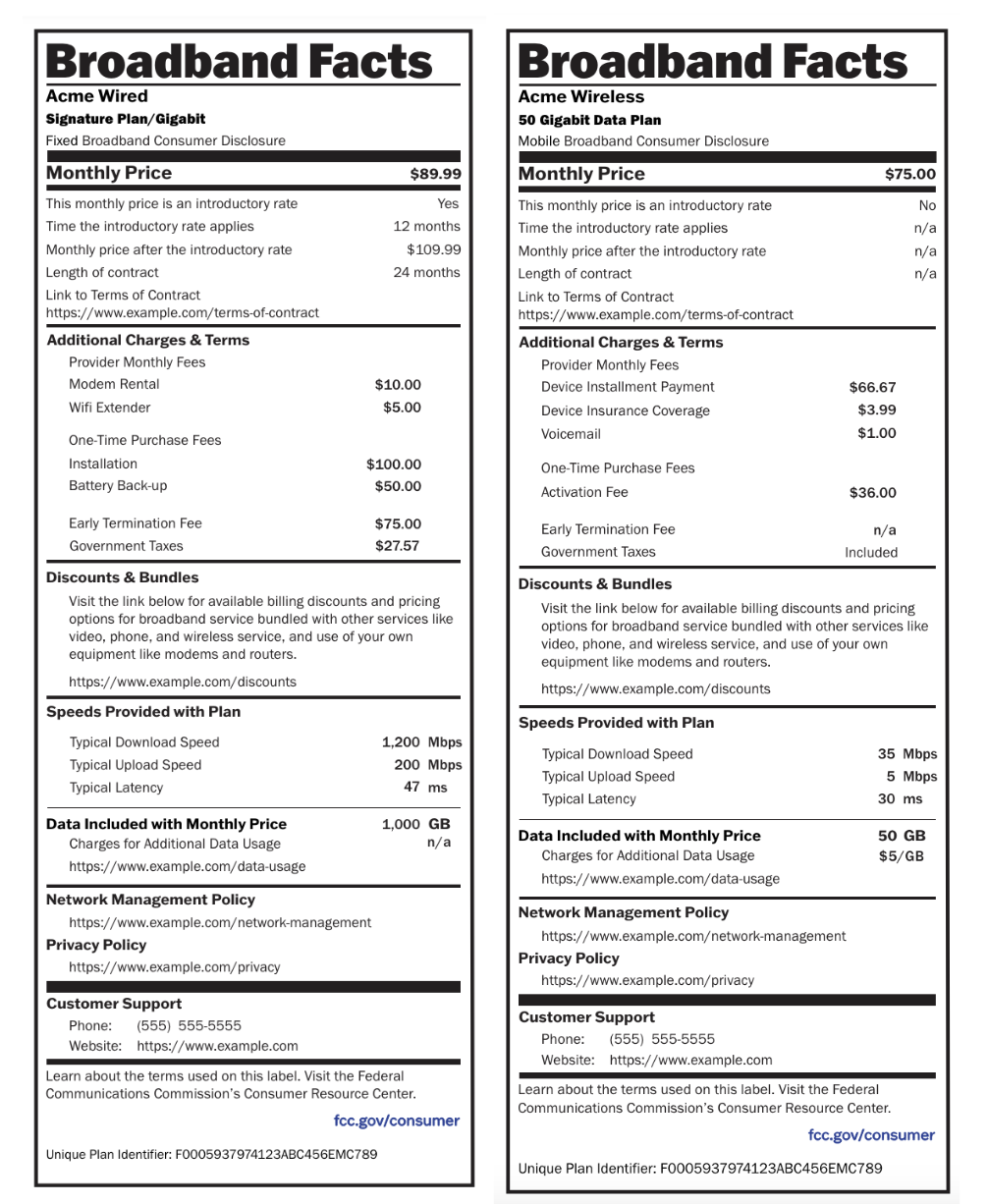
FCCBroadband labels: Check plan type, pricing details and contract terms
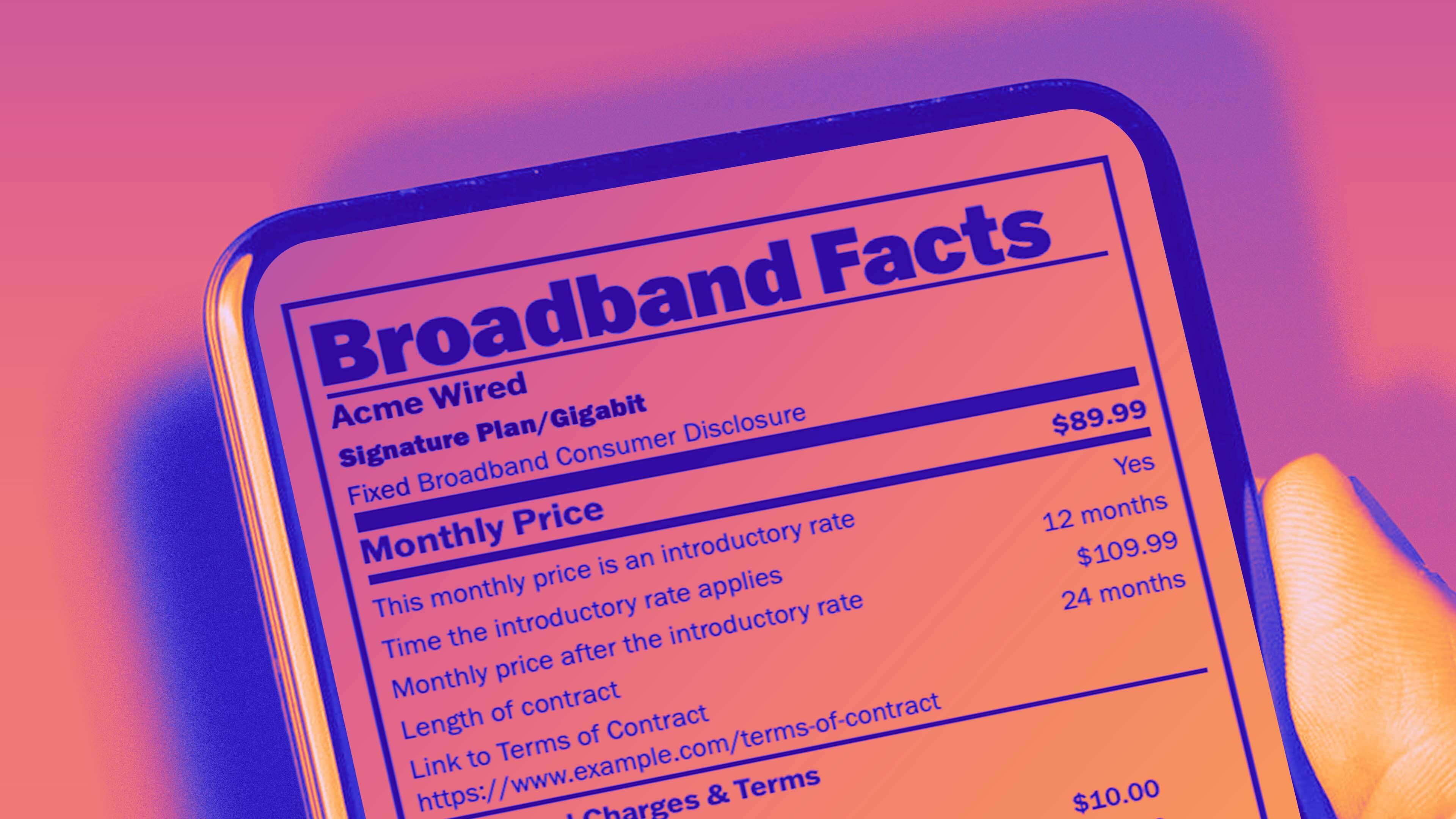
The Federal Communications Commission now requires ISPs to display clear details about the prices, speeds and terms of each of its plans on “Broadband Facts” labels, inspired by the classic nutrition facts labels found on food packaging. The facts labels must be placed before the point of sale, not after. The idea is the same: consumers deserve to know the critical facts about what they’re buying without marketing mumbo jumbo or other obfuscation.
These details might look a little intimidating at first, but don’t be spooked. They’re here to help. Up top, you’ll find essential info about the plan in question, including speeds, pricing details and the length of the contract. Crucially, the label will make clear if you’ll be paying a promotional price and, if so, how long it lasts and what you’ll be paying afterward. If trap pricing is in play, this is the easiest place to spot it.
Besides prices, these broadband labels will clarify the exact download and upload speeds each plan offers. They also indicate if the plan comes with unlimited data or if there’s a monthly data cap you should be aware of.
 FCC/Viva Tung/CNET
Don’t take the bait, stick to your script
Former CNET broadband reporter Cierra Noffke has had her fair share of experiences dealing with pricing traps from internet providers. When signing up for a 300-megabits-per-second plan from her internet provider, a persuasive and persistent customer service representative tried to get her to switch to a 500 Mbps or gigabit plan instead.
“She was making me second-guess myself,” Noffke said.
In the end, Noffke and her partner stuck to their guns. 300 Mbps was more than enough for their needs, thank you very much. The key? They understood their typical home internet usage before making the call.
“You really need to have your script and just write down everything that you’re going to say and just be strong with that,” Noffke wrote.
Call your ISP and negotiate your price
Former CNET staffer Danni Santana told me he first signed up for Optimum in 2018. He was paying about $45 a month for speeds of 300Mbps, but said he noticed that his monthly bill typically increased by $5 to $10 each year. Santana started a new yearly tradition of his own: calling Optimum to let them know he would be switching providers.
“You should always check your recurring bills,” Santana said.
A customer service representative is likely motivated to keep you as a customer, and that gives you leverage to negotiate. In Santana’s case, he was able to downgrade his plan to the speed and price he wanted while still keeping his HBO Max subscription.
Explore low-cost internet options or longer price locks
This might seem obvious, but one way to lower your internet bill is to switch to a cheaper provider. Most of the major ISPs offer entry-level plans at a good value.
You’ll still need to watch out for those pesky promotional price increases, but we’re also seeing a growing number of plans that promise to lock your price in for multiple years. For instance, Xfinity now offers customers a five-year price guarantee for all plans. You’ll pay more per month than you would with other promotional offers, but unlike with those discounted rates, your bill won’t shoot up after a year.
ISPs that offer long-term price locks
| Provider | Connection type | Promo / Price lock details |
| Xfinity (Comcast) | Cable | 5-year price lock available |
| Kinetic FIber | Fiber | 2-3 year price lock available |
| T-Mobile 5G | 5G Home Internet | 5-year price lock available |
| Verizon 5G | 5G Home Internet | 3-5 year price lock available |
| Verizon Fios | Fiber | 3-5 year price lock available |
| Optimum (Altice) | Cable / Fiber | 5-year price lock available |
| Mediacom | Cable | 2-3 year price lock available |
| Breezeline | Cable | 2,3 or 5-year price lock available |
| WOW! | Cable/Fiber | Price for life offer |
Some providers still offer cheaper internet rates to qualifying low-income households. Here are some of the most widely available discount plans in the country:
- Xfinity (Comcast): Offers Internet Essentials ($9.95 a month for 50 Mbps).
- Optimum (Altice): Offers Optimum Advantage ($15 a month for 100 Mbps).
- Sparklight (Cable One): Offers Economy Internet ($15 a month).
- Spectrum (Charter): Offers Spectrum Internet Assist ($20 a month).
- AT&T Internet: Offers Access from AT&T ($30 a month for 100 Mbps).
- Cox Communications: Offers ConnectAssist / Connect2Compete ($30 a month).
- Mediacom: Offers Connect2Compete ($9.95 a month for families).
- Frontier: Offers Frontier Fundamental Internet (at a Lifeline rate).
- Verizon Fios / 5G: Offers Verizon Forward (Up to $30 a month off home internet).
ISPs that don’t provide a standalone low-income plan usually accept or apply the standard $9.25 Federal Lifeline monthly credit or bill waivers to existing tiers. If you think your home qualifies for the discount, it’s worth asking your provider about it.
Is too much internet speed a thing?
Absolutely. In fact, paying more for speeds you don’t actually need might be the biggest pricing trap of them all.
The FCC uses the word “broadband” as a blanket term for high-speed internet. The specific speeds that meet the definition: download speeds of at least 100Mbps and upload speeds of at least 20Mbps. Those speeds are a good starting point for most homes, fast enough to handle everyday browsing, streaming in 4K, video calls and gaming online.
If your home is large and there’s a lot of ground for the Wi-Fi to cover, you might want something faster, as wireless speeds will drop over Wi-Fi the farther you are from your router. You also might want a faster plan if you’ll be sharing the connection with multiple roommates or family members. Still, even in circumstances like those, anything more than a modest speed upgrade might be overkill.
The most noticeable performance improvements will come from upgrading to a plan with faster upload speeds (particularly for video calls, file transfers and online gaming), or from upgrading to a better type of internet connection altogether. For instance, if you’re a cable subscriber but fiber internet is available in your area, then you should consider switching, as fiber plans offer better reliability along with upload speeds that are just as fast as the download speeds.
| Activity | Usage required | Our recommended speed |
| 1Mbps | 1Mbps | |
| Web browsing | 3 to 5Mbps | 5 to 10Mbps |
| Social media | 3 to 5Mbps | 10Mbps |
| Video calls | 3 to 5Mbps | 10 to 20Mbps |
| HD streaming | 5 to 10Mbps | 10 to 20Mbps |
| Online gaming | 3 to 6Mbps | 25 to 35Mbps |
| 4K streaming | 25Mbps | 35Mbps |
To learn more, read our guide on how much speed your household needs.
What’s the bottom line on internet pricing traps?
There’s no need to settle for paying too much for your home internet connection. Your best bet to avoid these broadband pricing traps is to do some research before signing up and stay vigilant when you hear these promotional offers from ISPs. Remember, a provider might offer enticing incentives upfront, but it’s essential to understand what you’ll be paying after those promotions expire.
If you’ve already gotten yourself stuck in a pricing trap, don’t give up hope. Call your provider to see if you can negotiate a new plan with a lower rate. If they won’t budge, call the competition and switch. Whatever you do, stay patient, persistent and polite.
Expensive Bills? You Can Save on Your Internet Bill With These 8 Simple Tips
Broadband pricing trap FAQs
What are pricing traps?
Pricing traps are tactics that businesses use to lure customers into paying more for a product or service. Some of the most common pricing traps that internet providers use are promotional rates that expire, early termination fees, overage fees from data caps and the added fees from bundling your home internet with mobile or TV.
How do you avoid pricing traps from ISPs?
The short answer is research. Doing research and understanding your home’s actual speed needs before signing up can save you a lot of money in the long term. Your ISP is required to provide broadband fact labels for each plan offered with clear, straightforward information about pricing, speeds and terms.
What are low-cost internet options?
Most providers offer entry-level plans at a decent rate, though you’ll want to keep an eye out for promotional rates that increase after a year. Some ISPs also offer low-cost internet plans to qualifying customers.
How much internet speed do you need?
The FCC defines a high-speed, “broadband” connection as one with download speeds of at least 100Mbps and upload speeds of at least 20Mbps. That’s a fair starting point for most homes in the US, offering enough speed for everyday browsing and streaming, video calls and gaming online. Upgrading to a faster plan might be worthwhile if your home is large, as Wi-Fi speeds will drop the farther you are from the router. You might also want more speed if you’ll be sharing the connection with multiple people.
Which internet providers offer no-contract services?
Most ISPs don’t use contracts anymore with termination fees attached. Most still offer promotional pricing with an expiration date.

See full bio

See full bio
Read the full article here