


When it comes time for a big computing show, you can always count on Lenovo to exhibit some wacky proof-of-concept machines.
At CES 2026, for instance, the Chinese company debuted an AI-powered tracking webcam and a horizontal rollable gaming laptop display. Just this year, my personal favorite gaming handheld prototype debuted at Mobile World Congress, alongside a detachable dual-screen ThinkBook concept. Now, Lenovo’s coming out swinging again with its IFA 2026 exhibition – the company debuted two new concepts this time around in Berlin.
Project Swan is a 14-inch consumer laptop that can easily be toted around from place to place, before its horizontally rolling screen extends to 17 inches for work or entertainment. Project AeroBlade introduces a completely new ventless cooling system that minimizes noise pollution and supposedly doesn’t require any major compromises in compute performance.
If theoretical and fantastical concepts aren’t what you’re looking for, you’re boring and probably lack whimsy. But fret not, because Lenovo debuted plenty of products that it’ll be bringing to market over the course of the next 12 months, including a new type of OLED monitor, beefy (and expensive) desktop PCs and a handful of new consumer laptops.
The Project Swan concept takes Lenovo’s rollable laptop screens in a new direction
Lenovo has never shied away from funky device displays. The company released or has shown off concepts for computers with vertical motorized rolling screens, laptop displays that wrap around the top lid to show off widgets while closed and screens that turn to keep you centered in the built-in webcam. At this year’s Mobile World Congress, Lenovo even showcased a prototype handheld gaming console with a folding screen that works in horizontal and vertical configurations.
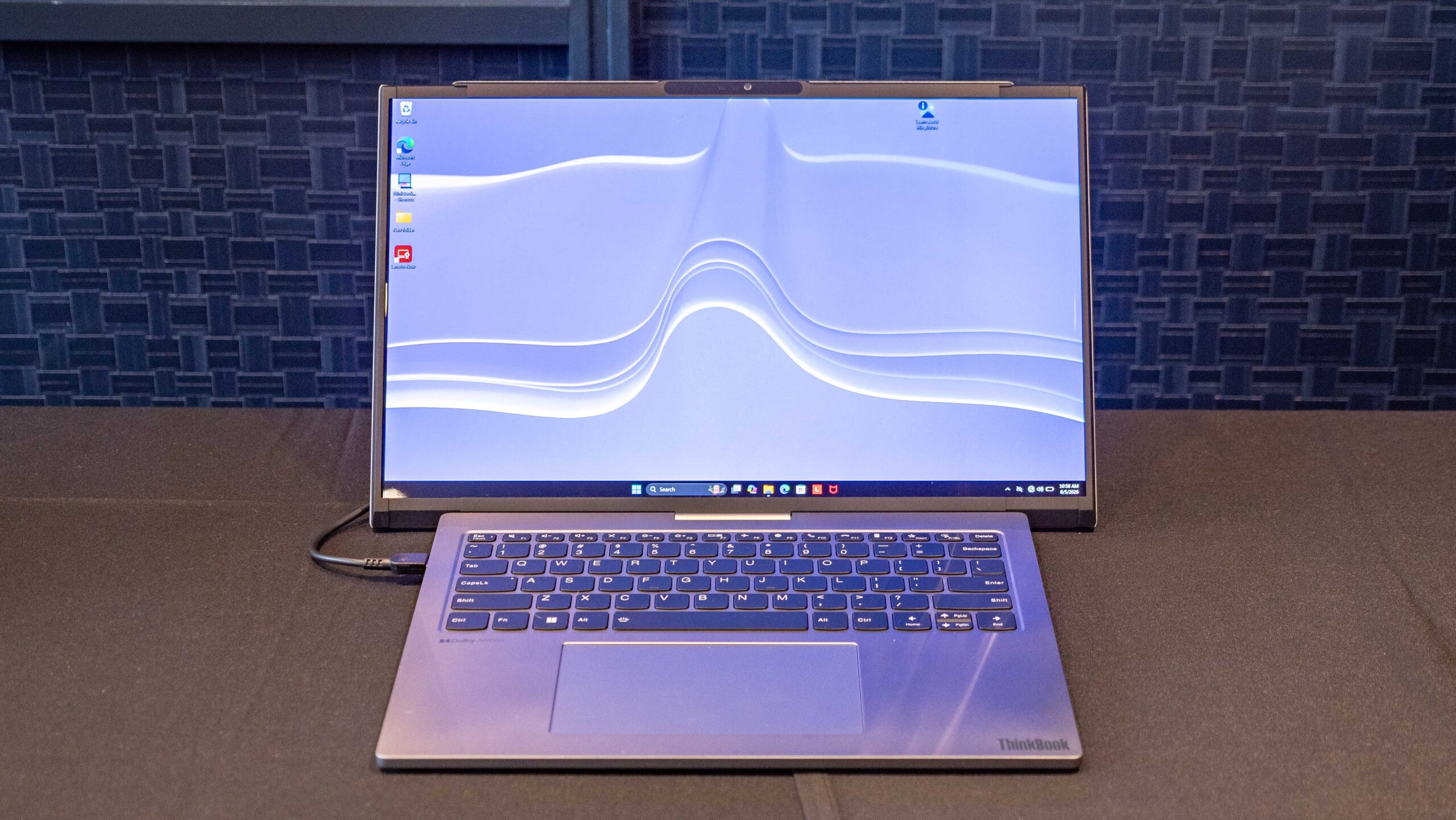
The company is keeping the ball rolling at IFA with Project Swan, its first horizontally expanding, rollable work laptop. The 14-inch device can extend into a 17-inch display at the touch of a button. It’s a very large screen packed into one of the most portable clamshell designs possible.
The Legion Pro Rollable, shown off at CES 2026, uses much the same technology — but that was a gaming-centric laptop, tailored toward first-person shooters and other games that benefit from a wide field of view. I’m not sure how folks will respond to the deluge of laptops with rollable displays, but by my estimation, the Project Swan concept is one of the most practical Lenovo has shown off yet.
This seems like the starting point for a solid workhorse laptop: I can imagine using it for work and packing it away for trips, then unfurling the screen to use the computer for periods of high-productivity multitasking – or as a portable entertainment center for movies and shows. If this concept ever comes to fruition, it might be the most family-oriented rollable in Lenovo’s stable.
The Project AeroBlade concept might save your legs from getting toasted
I don’t know about you, but I’m tired of singeing my legs when I push my laptop a little too hard and the vents dump all that excess heat right into my lap. I also hate when I’m bundled up under a blanket and the blocked fans start whirring concerningly loud.
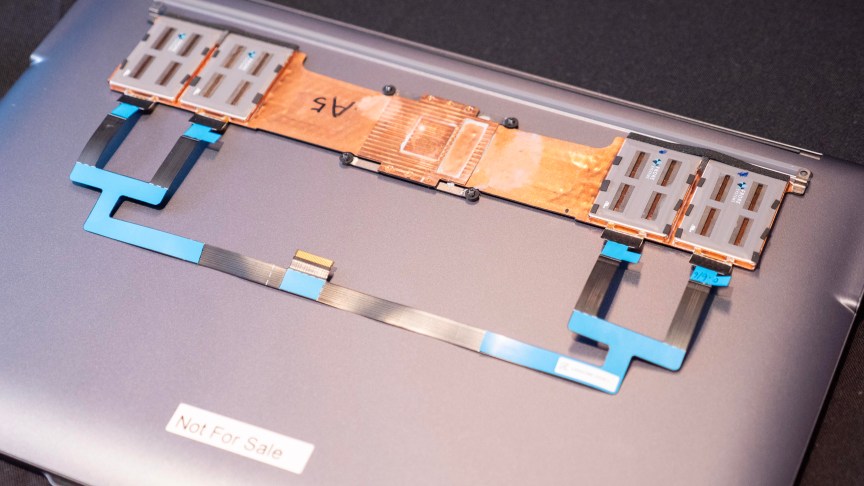
Lenovo’s Project AeroBlade feels like the type of concept device that would tangibly improve just about any laptop user’s experience. This 14-inch ultraportable laptop has a new fanless design that Lenovo says won’t compromise performance. Instead, there’s a single vent running along the hinge, which allows outside air to pass through the internal thermals. And moving air through the laptop aren’t fans but tiny modules that use ultrasonic vibrations. Lenovo calls this vibrating cooling tech AirJet.
At a press event in New York, a member of Lenovo’s design team explained that the new cooling design is more akin to “a bike pump than a leaf blower.” Whereas the average laptop dumps heat in a single direction, Project AeroBlade pulls in cool air from its surroundings and circulates it through the inside of the laptop.
Whether or not this iteration of Project AeroBlade comes to fruition, it’ll be interesting to see if Lenovo’s new cooling solution ever makes it to the market. A cooler, quieter and higher-performance system feels like more than a marketing gimmick – if it works as advertised, this could seriously sway consumers toward a better type of laptop design.
The ThinkVision P27UL-40 monitor is Lenovo’s first InkJet printing OLED display
If you’re looking for a best-in-class monitor, odds are good you’re looking for a display with an OLED panel – the quicker response time gives the tech an edge over IPS LCDs. But while OLED monitors have become significantly more affordable over the past decade, they’re still a bit too pricey for some folks.
Those prices may start to come down an appreciable amount again in the near future, thanks to new inkjet-printing OLED tech. These displays literally use a printer to deposit organic material on a glass layer thousands of times per second.
The result is a display that doesn’t compromise color contrast or picture quality, though it hasn’t achieved anywhere close to the same level of brightness as traditional OLEDs. Some analysts believe the IJP OLEDs might cut production costs by up to 20%, and some of those savings will be passed on to the consumer.
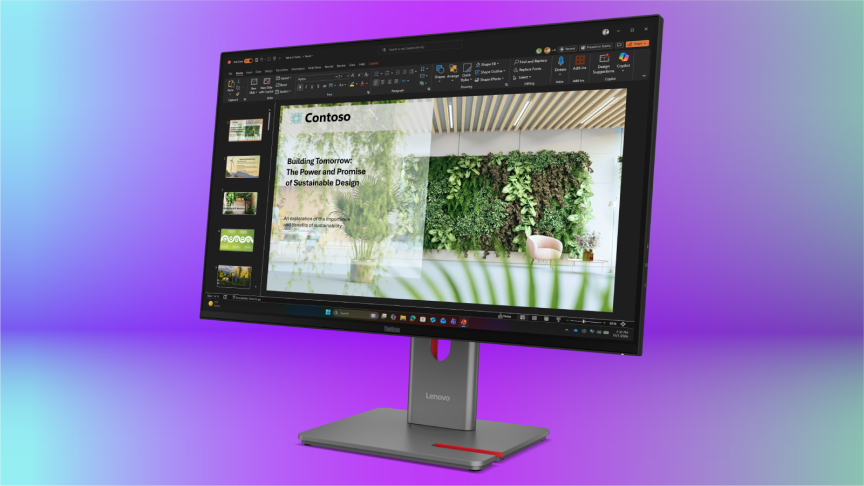
Lenovo isn’t the first to create a consumer IJP OLED screen, but the ThinkVision P27UL-40 is the first inkjet-printed monitor the company is bringing to the market. This 27-inch monitor has a 3,840×2,160-pixel resolution panel and an up to 120Hz refresh rate.
The ThinkVision P27UL-40 will be released in March 2027, starting at $1,300, which is still a significant chunk of change. But if industry analysts are right, this might be the start of a trend leading to more competitively priced OLED monitors.
Other ThinkVision monitors also debuted at IFA 2026, but none of those models use the same IJP OLED technology as the ThinkVision P27UL-40. Instead, they’re rather standard LCD monitors.
The ThinkVision T32WD-4v is a 32-inch IPS monitor with 3,840×2,160-pixel resolution and an up to 120Hz refresh rate. It’ll start shipping in February next year and start at $900.
The ThinkVision T34WD-4v is the larger addition to the ThinkVision T series lineup: It’s a 34-inch VA monitor with 3,440×1,440-pixel resolution and an up-to-120Hz refresh rate. That monitor will start shipping in January with a starting price of $1,000.
The ThinkCentre X Ultra desktop is a rather robust AI-first workhorse
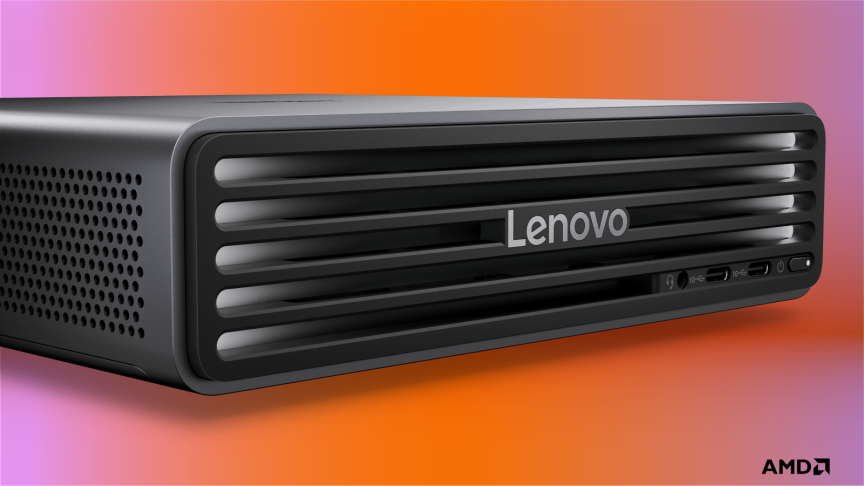
If you’ve got enough pocket change to ignore the surging hardware costs spurred by the RAMageddon, maybe Lenovo’s new ThinkCentre X Ultra desktop PC is for you. This veritable powerhouse is an “AI-first” juggernaut, with a design crafted to optimize compute power (though a computer like this could realistically handle most tasks you throw at it).
This 4.4-pound computer is powered by AMD silicon, housing an up-to-Ryzen AI Max Plus Pro 495 processor. It features integrated graphics, up to 128GB of RAM and 8TB of system storage. There are two expansion slots for additional SSDs, assuming you have the cash for upgrades after buying this desktop. The ThinkCentre X Ultra will be released in November at a starting price of $3,700.
Alongside the ThinkCentre X Ultra, Lenovo is debuting two other desktop PCs. The 2.6-pound ThinkCentre M75q Gen 6 is even more compact than the Ultra, but still retains some beefy AMD processing power. This desktop is powered by up to Ryzen AI 7 Pro 450GE silicon, has integrated Radeon 860M graphics, up to 64GB of RAM and 4TB of storage space. The M75q Gen 6 will be available later this month at a starting price of $1,380.
The ThinkCentre M75s Gen 6, on the other hand, is the largest desktop PC in the new lineup. Weighing in at 10.6 pounds, this computer is powered by an up-to-Ryzen AI 7 Pro 450G processor, 64GB of RAM and 4TB of storage. Different configurations come with integrated Radeon 860M and Radeon RX 6400 8GB graphics. The M75s Gen 6 will be available next month at a starting price of $1,490.
Two new sleek and slim 14-inch ThinkBooks
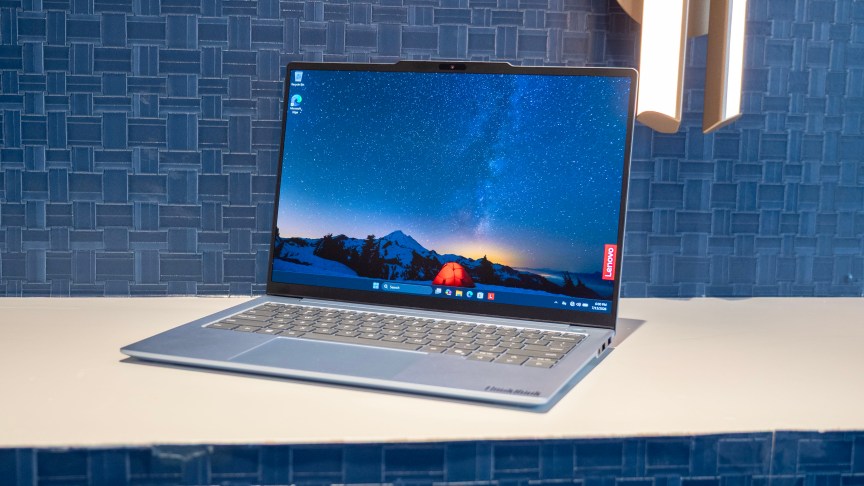
Lenovo may not have debuted any wacky new ThinkBook concepts at IFA, but the company showed off two new 14-inch iterations of its popular work laptop lineup that will begin shipping soon.
The ThinkBook 14 Gen 9 is a balanced 2.8-pound laptop, packaging a decent 14-inch, 1,920×1,200-pixel resolution display and solid internal specs into a single clamshell. It’s powered by a Qualcomm Snapdragon X2 Plus processor and a Qualcomm Adreno GPU, and has up to 32GB of LPDDR5x RAM and a 1TB SSD (with the option to slot in a second SSD). The ThinkBook 14 Gen 9 will be released next month with a starting price of $1,300.
The ThinkBook 14x Gen 2 is the sleek ultraportable offering, weighing just under 2.2 pounds. Lenovo packed some decent hardware into this clamshell despite its diminutive size, and the optional 2.8K OLED screen will provide snappy color contrast that’ll satisfy most folks.
The ThinkBook 14x Gen 2 is powered by Intel Core 7 Series 3 silicon, integrated graphics, up to 32GB of LPDDR5x memory and 2TB of storage space. It will be released in early 2027 and start at $1,000.

See full bio
Read the full article here