


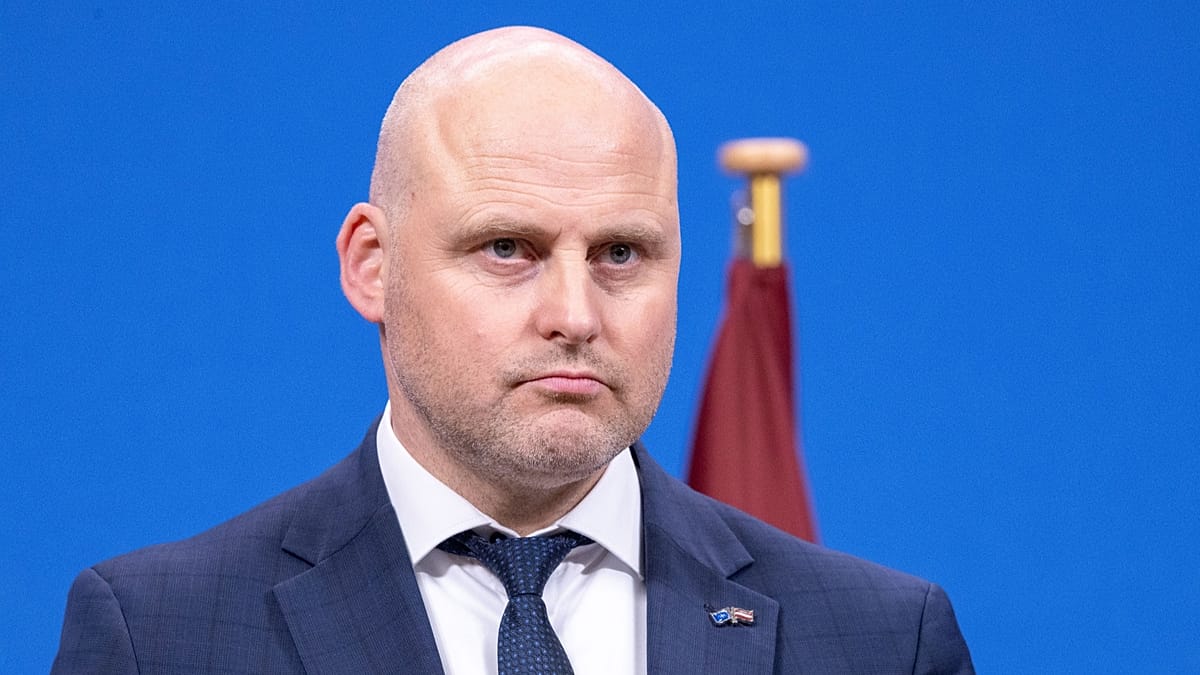
Latvian Prime Minister Andris Kulbergs said his country “stood to the end” to prevent two Russian oligarchs from being delisted from a sanctions package but concluded alongside Ukraine it was best to compromise for a salvo.
But he warned that the exemption should be a one-off occurrence and not be par for the course when debating EU sanctions in the future.
“Either it is sports, what we’ve seen, either culture, and now one by one cherry-picking out of sanctions, that is not the way to go,” he said.
“That is normalising Russia.”
After two weeks of drawn-out talks among EU ambassadors, France succeeded in its push on Tuesday to remove Alisher Usmanov from the sanctions list as part of a prisoner release with Azerbaijan brokered by Uzbekistan, Usmanov’s home country.
A second high-profile businessman, Mikhail Fridman, was also removed after Slovakia called for his delisting.
Luxembourg, meanwhile, had argued that if Usmanov was removed, Fridman should be too. Fridman has filed a $16 billion claim against Luxembourg over his frozen assets.
The asset freeze and travel ban in place since 2022 will be lifted as a result.
Kulbergs was the main objector to a proposed compromise. After it was tabled on Monday, he took to social media to present his red lines, making it clear that while Latvia supported extending the blacklist for 36 months, it did not back removing the two names from the list as part of the deal.
Until now, the bloc had rolled over its sanctions every six months, creating constant opportunities for countries to veto and extract concessions. The three-year extension is meant to offset the political pain of delisting the two high-profile businessmen.
The sanctions list currently includes nearly 3,000 names, organisations and entities accused of supporting Russia’s war in Ukraine, including Russian President Vladimir Putin.
Kulbergs told Euronews that he dropped his opposition because “we all understood it is not worth risking” the whole EU sanctions package.
Asked what legacy the episode would leave behind for future negotiations regarding EU sanctions policy, Kulbergs told Euronews that it was not a good one, though he welcomed the 36-month timeframe.
“I’m worried about the playbook which it leaves,” he said.
“I don’t think this is a very good example, because that gives a message. ‘Oh, we arrest some politicians somewhere, and then we can ask for a sanctions package.’ This is not a good playbook, and that’s exactly why we froze it for 36 months. That’s it. No discussion.”
Latvia, together with fellow Baltic states Lithuania and Estonia, has long advocated a strategy of maximum pressure on Russia. The country is heading to the polls for a parliamentary election next month.
Before lifting Latvia’s objection, Kulbergs spoke with French President Emmanuel Macron, whose country led the push to remove Usmanov from the sanctions.
Paris has not yet acknowledged the prisoner release with Azerbaijan and instead cited a “national security” reason to justify its controversial request.
Kulbergs said: “I cannot communicate and I cannot know the reasons behind the national security aspects of each of those countries’ positions.”
He added, however, that the vulnerability of Europe’s eastern flank, which includes Latvia, puts it in good stead to potentially join France’s nuclear deterrance programme.
“It’s important for the eastern flank, for us, to have the coverage of their security,” he said.
The United Kingdom, Germany, Poland, Sweden, the Netherlands, Belgium, Greece, Denmark, and Norway have already signed up to France’s initiative, which aims to deepen nuclear cooperation across Europe through joint exercises.
Under the framework, participating countries could also potentially host French nuclear-capable aircraft on a temporary basis.
Paris would, however, retain exclusive control over its nuclear arsenal, with the final decision on its use resting with the French president.
Following Tuesday’s agreement, the Latvian government confirmed that it would apply sanctions on Usmanov and Fridman at the national level. Kyiv has urged other member states to follow suit.
Read the full article here