


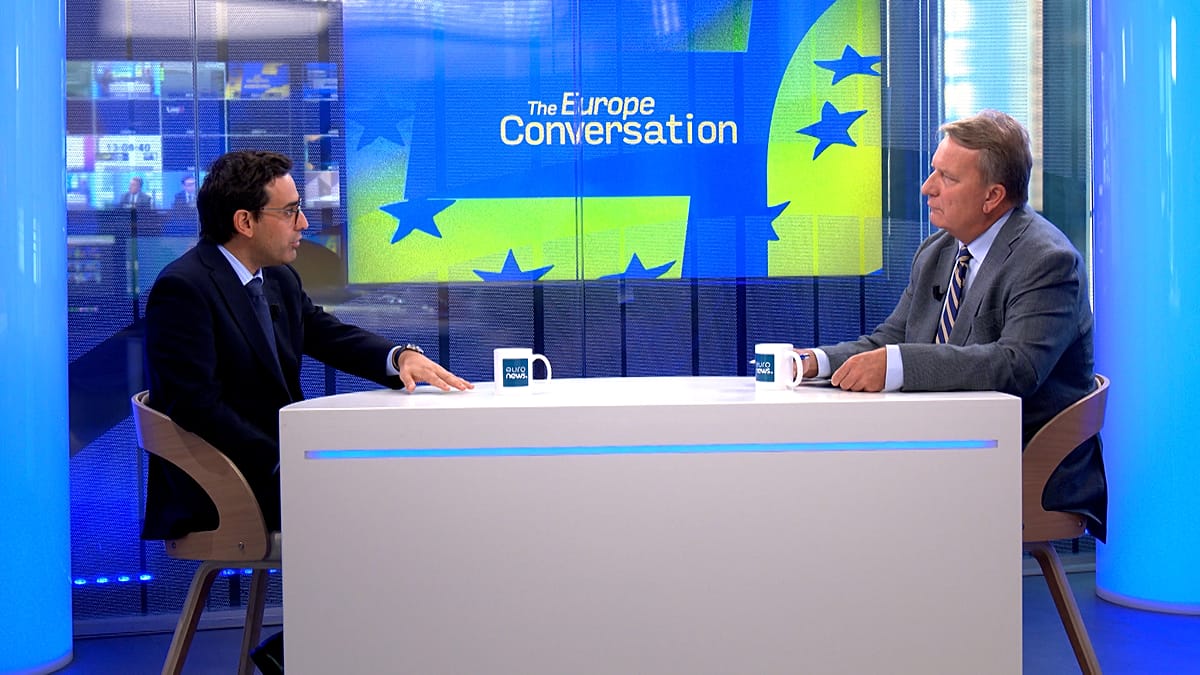
The European Union “urgently” needs to act quickly to rebalance its “unsustainable” trade relationship with China, Commission Executive Vice-President for Prosperity and Industrial Strategy, Stéphane Séjourné, told Euronews, stressing that significant job losses are at stake.
Recent customs data showed the gap between the bloc’s imports from China and exports to China, the trade deficit, ran at more than €1 billion a day in July.
“This trade rebalancing is becoming existential for Europeans,” Séjourné said on Euronews’ interview programme The Europe Conversation.
“Today we’re losing thousands of jobs every week,” he noted, adding that the EU already lost 250,000 industrial jobs last year. These were particularly concentrated in energy-intensive sectors and automotive supply chains. “It’s urgent that we act, and urgent that we rebalance.”
The EU, meanwhile, began crucial negotiations with Beijing in June this year, and has set a looming October deadline for concrete, “credible” outcomes. This will culminate in a high-stakes visit by EU Trade Commissioner Maroš Šefčovič to Beijing on 8 and 9 October, where Brussels is hoping to secure commitments from China that it will curb exports to the EU.
“The European Commission has put forward a proposal to the Chinese side to discuss this sector by sector and look at how we can rebalance things,” Séjourné said. “This imbalance isn’t sustainable, not for China or for the EU.”
However, so far, Beijing has been resisting calls from the Europeans, pushing back against calls for voluntary export curbs.
The EU Industry Commissioner said that negotiation and discussion will be “given a chance,” but that the Commission has been clear on the consequences of talks not producing the results.
“Trade defence tools are on the table,” he warned. “Today we need credibility in how we use these tools, and we won’t hesitate to use them to rebalance things.”
Tools currently on the table include anti-dumping duties and tariffs against unfair subsidies (in industries such as electric vehicles and solar panels).
But Brussels is walking a tightrope when it comes to defending the EU market, as Chinese retaliation could see the country restrict exports of rare earths, essential to several of the EU’s key industries, including defence.
Watching US-China talks
The EU will also be keeping its eye on talks between Washington and Beijing. Chinese President Xi Jinping is landing in the United States for a three-day summit with US President Donald Trump, which is set to cover issues ranging from trade to AI and rare earths.
The outcome of these talks between the two economic superpowers could directly affect Europe’s economic interests, Séjourné explained.
“We need a constructive dialogue between China and the United States. As we saw last year, the trade escalation between Washington and Beijing on these issues could spark a trade war, one that could even affect the European economy.”
Last year, an explosive tit-for-tat trade war saw the US and China hike tariffs on each other’s goods to dizzying heights. At the peak of this battle, the US imposed 145% tariffs on Chinese imports, while Beijing’s retaliatory duties reached 125%.
For Europe, a trade war between the US and China hits hard, as astronomical tariffs on China inevitably lead to the diversion of Chinese goods from the US to the EU.
On the agenda this week in the US will be the looming expiration of the trade truce, due to expire on 10 November.
“I hope this dialogue can be constructive, that an agreement can be reached, and that the situation can be stabilised,” Séjourné concluded.
Read the full article here