


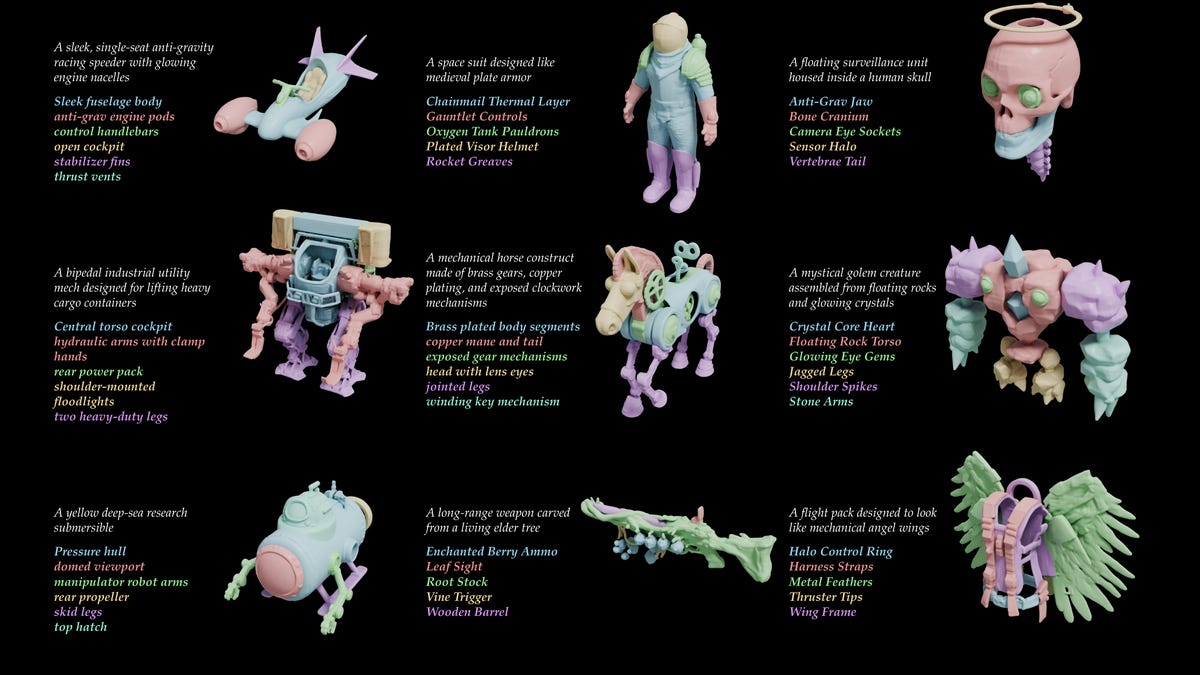
Imagine you’re playing a racing game and you’re AI-generating the car you’ll use. Or a sandbox battle where you’re making all your machines and weapons on the fly. Centipede tank with four turrets? Flying bat drone? Roblox is folding its new CubePart AI model into its platform and game developer tools, and it’s going to mean kids and other players generating things in games that actually do stuff with moving parts.
CubePart AI, an open-source AI model Roblox has just published research on and will be introducing its platform, is an extension of 3D AI-generated objects that Roblox introduced last year. This time, though, objects can have actual working parts that fit the physics of the game they’re in.
AI models for creating multipart objects already exist, but Roblox argues, in a new research paper, that its model is better, promising training on more objects than other models (2 million parts, and a half million overall assets) and being able to label parts of objects using AI faster. The result could be actual functioning things that can work in games using existing game engines.
AI-generated moving tanks, robots or surveillance skulls?
The model-creating AI will work in Roblox Studio for developers, but also be accessible for players in games that support it starting today.
“Our dream is that any two-person studio is able to create a massive complex game, but if you take it further and further, then why not have more and more of our players become creators, even without having to open a full-scale studio product?” Anupam Singh, Roblox’ senior vice president of engineering, tells me on a chat over Zoom.
Weird examples in Roblox’s research paper of what could be made show exactly how strange it could get: a “floating surveillance unit housed inside a human skull,” with cameras, moving vertebrae and a “sensor halo.” Or “a long-range weapon carved from a living elder tree,” with enchanted berry ammo and a vine sight.
This won’t be isolated to some sandbox that’s off to the side somewhere — it’s something you’ll be able to bring directly into your in-game activity. “The trick that we have found is, unless you integrate it into very interesting gameplay, after a while it becomes a little bit boring,” Singh says. “You’re generating an object, but then you need all this other gameplay stuff around it.”
The moving creations can’t be endless — Singh says that natural fail points will dictate limits to keep things from getting too big — and they can’t distort and move quite like living creatures yet, so it’s intended more for machines and suits and vehicles than aliens and companions, although golem-like robots are possible.
More sample examples of AI-generated 3D multi-part creatures, weapons, vehicles and other oddities made using the new AI model.
Where are the limits?
I saw signs of Roblox’s generative AI ambitions back in 2023, but the state of things in 2026 is much weirder. And much of its vision is already possible. But whether my kids or anyone else will want to do it remains to be seen. When I told my 13-year-old Roblox-playing kid all about the AI changes, he just made a sour face and asked “why?” Parents may feel the same way.
Singh told me that while the possibilities are immense, the creation of any object will be moderated the same way that AI-generated content was handled previously, and freeform AI generation will be contained to games that developers choose to include the new model in — it’s not just a power you can summon anytime. Still, where will all these pieces take us, and will the AI costs associated with these generative tools be feasible in the long run without a subscription?
World generating is the next step
The new CubePart AI capabilities are yet another step toward increasingly realistic and spontaneously generated shared worlds. Roblox Reality, coming later this year or in early 2027, aims to make games that run at 2K resolution and 60 frames per second using AI — a service that apparently will have some subscription tied to it.
There’s also an even weirder initiative, called Game Cartridges, that’s aiming to explore collaborative experiences in AI-generated worlds. Right now, generative AI is mostly a solo thing, not collaborative — and it’s still hard to get generative AI to make changes to something that’s already been made.
Singh says that AI isn’t good enough yet to make world models that can stay stable enough for multiplayer collaboration or play, but the playable demos in Roblox’s World Research Station show a sign of what’s coming: It’s similar to what Google is aiming for with its Genie 3 3D world-building generative AI, which launched in February.
The idea of generated worlds and creations on the fly gives me metaverse echoes, and for a company like Roblox that’s essentially been a metaverse of its own, it makes me wonder when things like this could come to VR headsets like Meta’s, or even augmented-reality glasses.
“We don’t use the word metaverse anymore, but let’s think about what the metaverse is. It is an entire complex scene, which you can jump into and interact,” says Singh. “World models are invariably single player. But what if [everyone] could be in the same world and, when you change the world state, I would be able to see it. That multiplayer collaboration is what will make world models interesting.”
CubePart is just one piece in a moving Roblox AI puzzle, but Roblox isn’t the only company pushing toward generative worlds. Instead, think of Roblox as a canary in the gaming industry mines. It’s where a lot of studios could very well be heading.
Read the full article here