


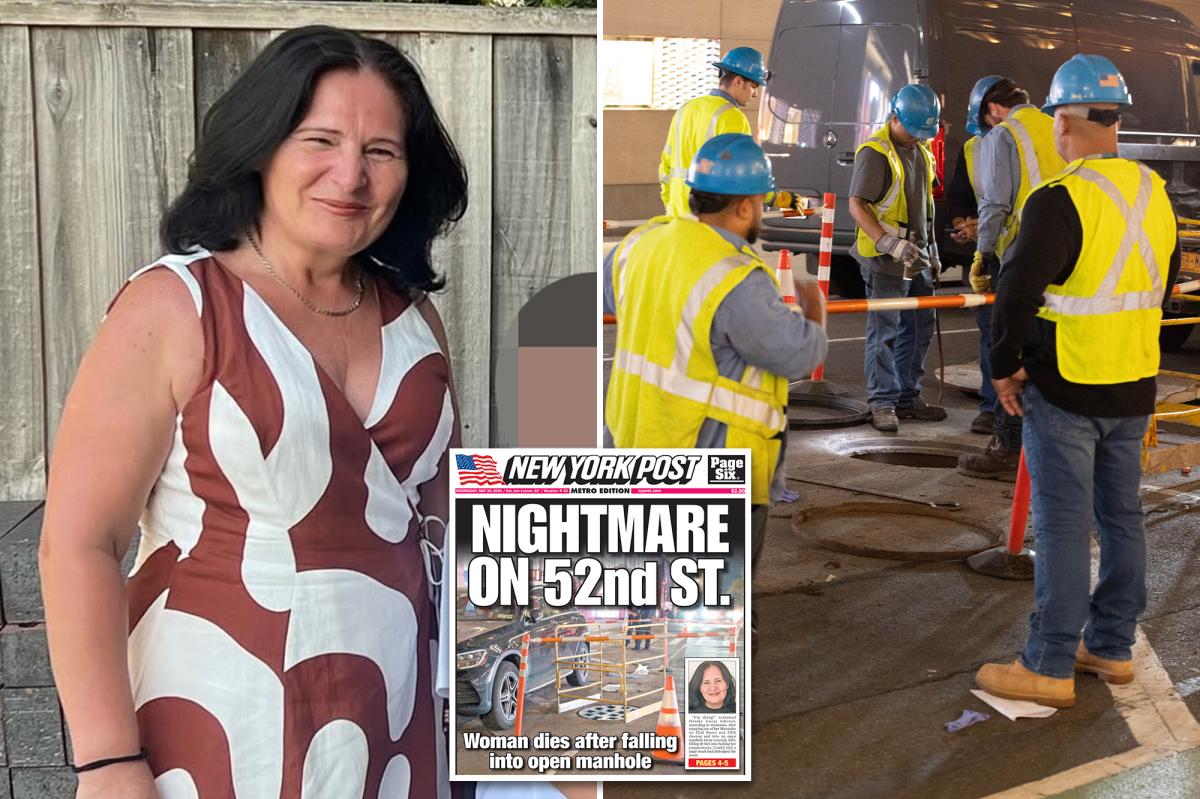
The heartbroken family of the grandmother killed after falling into a steaming, open manhole two months ago has filed a wrongful death suit against Con Edison for failing to secure the access point that also left her long-term boyfriend burned and bedridden.
Donike Gocaj’s family and partner filed the lawsuit against the utility company in New York Supreme Court on Thursday, alleging the utility company’s negligence led the Westchester woman to plunge into the uncovered, sweltering utility hole on May 18.
Gocaj, 56, had stepped out of her vehicle to meet up with her boyfriend, Jashar “Jack” Kameraj, between work shifts that night when she plummeted into the manhole near East 52nd Street and Fifth Avenue, family attorney Howard Hershernhorn told The Post.
The hardworking mother screamed, “I’m dying, I’m dying,” as Kameraj tried to get down into the manhole to retrieve her, and terrified bystanders ran up and down the street in search of a ladder to pull her to safety.
But Gocaj eventually succumbed to horrific scald burns, inhalation thermal injuries, and blunt force trauma as she remained trapped.
Kameraj also suffered devastating inhalation thermal injuries and burns while trying to save Gocaj, leaving him now bedridden, according to the lawsuit filed by the firm Gair, Gair, Conason, Rubinowitz, Bloom, Hershenhorn, Steigman, and Mackauf.
“It was a frantic scene, right there with everybody trying to save her because they could see her through the hole. They could hear her through the hole, but they could not help her,” Hershenhorn said.
“And Jack … she was really his family, and she was the closest person to him, and they would see each other all the time, every day, and they were extremely close,” he added.
Gocaj’s family now claims that ConEd endangered Gocaj, Kameraj, and scores of New Yorkers by not implementing proper safety measures to prevent manhole covers from dislodging.
The company knew that its manhole covers, including the one Gocaj fell into, could “become dislodged and displaced by, among other things, vehicle traffic and/or heavy vehicles,” the filing alleged.
A representative for ConEd previously told The Post that a passing truck appeared to have dislodged the utility hole’s cover less than 15 minutes before Gocaj arrived Monday night and parked along the avenue.
“Assuming that what they said is true, that a truck passed over it and dislodged it, it’s pretty obvious negligence that it wasn’t placed back correctly by Con Ed, who is responsible for that manhole cover,” Hershenhorn said.
Between January and February alone, there were more than 3,200 complaints filed with the city about manhole hazards, Gocaj’s attorneys argued
“This is not a one-time incident,” Diana Carnemolla, counsel for the grieving family, said in a statement. “The data shows systemic failure. Con Edison has known for decades that heavy vehicle traffic displaces manhole covers. It has known how to prevent this. And it has chosen to do nothing.”
The utility company, which maintains roughly 285,000 manholes, should implement stronger manhole locking systems, a real-time monitoring system to detect whether covers have been displaced, and secondary safety devices to catch people if they manage to fall into one, the attorneys said.
The family is now seeking an unspecified amount of compensatory damages to cover the severe physical, emotional, and financial devastation suffered by Gocaj, her surviving children, and her partner. They are also demanding punitive damages to penalize Con Ed.
“We extend our condolences to the family and loved ones of the deceased,” a spokesperson for the company said in a statement. “Because the matter is pending litigation, we cannot comment on specific allegations or legal proceedings. Con Edison will review the complaint and respond through the appropriate legal process.”
Gocaj’s attorney said the mom and grandmother sacrificed everything to give her family a good life.
“This is a woman who lost her husband 20 years ago, and she raised these two kids by herself, working two jobs, both jobs that most people don’t wanna do, meaning cleaning banks and buildings and toilets,” Hershenhorn said. “But she did that so she could give her kids an education, so that she could give the kids a home, and then she was able to accomplish all of that.”
“There’s no amount of money in the world that could have replaced this lady, and there’s no amount of money in the world that could compensate her or the family for her pain and suffering,” he said.
“More important than any of that is to make sure that this never happens again.”
Read the full article here