


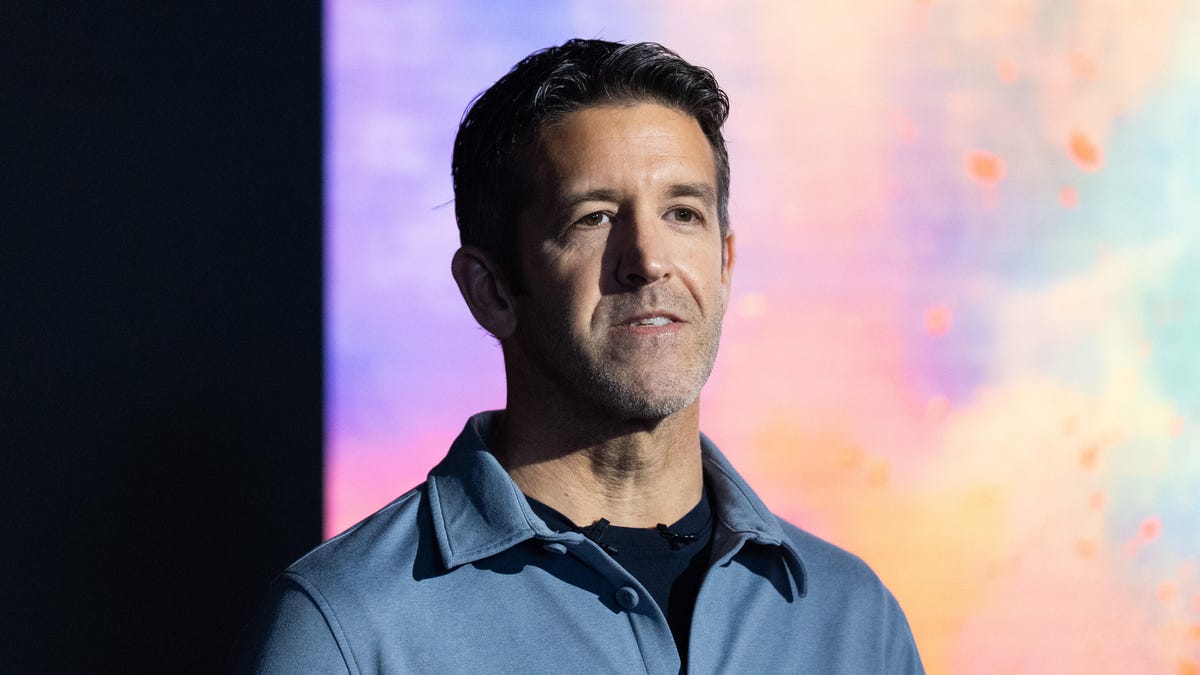
When incoming CEO John Ternus assumes leadership of Apple later this year, he’ll inherit a series of significant challenges facing the tech giant. But his decades of experience within the company should position him well to navigate those tides.
Ternus, whom Tim Cook named as his successor on Monday, currently serves as Apple’s senior vice president of hardware engineering until Sept. 1. Cook will transition to become executive chairman of Apple’s board of directors.
Cook has led a fruitful era for Apple, to say the least. He became CEO in 2011 and oversaw the launch of products like the Apple Watch, AirPods and AirTag. Under his leadership, the tech giant leaned heavily into services like Apple TV, Apple Music and Apple Fitness Plus — a savvy financial move as consumers cling to their devices longer. The collective decisions clearly paid off, as Apple became a trillion-dollar company in 2018 and hit $4 trillion in October.
Ternus will take the lead as Apple navigates a landscape increasingly shaped by AI and fraught with tariff uncertainty. Apple maintains a strong and loyal customer base, consistently scoring the top spot in global smartphone shipments. Now, it’s all about maintaining and building on that trajectory. We don’t know what new directions Ternus will go once he inherits the role, but we can look to his career for insight on where he’ll take the company.
Who is John Ternus?
Ternus began working at Apple in 2001 as part of the product design team. He became vice president of hardware engineering in 2013 and was bumped up to senior vice president in 2021.
Unlike Cook, whose strengths before becoming CEO were in logistics and supply chain management, Ternus has been a down-to-the-screws product guy during his 25 years at Apple. He’s worked on products including the iPhone, iPad, Apple Watch, AirPods and the MacBook Neo. Before his tenure at Apple, he was a mechanical engineer at Virtual Research Systems. He has a bachelor’s degree in mechanical engineering from the University of Pennsylvania.
“John Ternus has the mind of an engineer, the soul of an innovator and the heart to lead with integrity and with honor,” Cook said in a statement. “He is a visionary whose contributions to Apple over 25 years are already too numerous to count, and he is without question the right person to lead Apple into the future.”
Apple says Ternus led materials and hardware design innovations, including a recycled aluminum compound and 3D-printed titanium in the Apple Watch Ultra 3. He led “development of the AirPods and the company’s first 5G phones,” according to Bloomberg, and helped transition the Mac from Intel processors to Apple silicon. He also reportedly led hardware engineering for the first iPad and spearheaded efforts to add new models to the company’s lineup.
“Having spent almost my entire career at Apple, I have been lucky to have worked under Steve Jobs and to have had Tim Cook as my mentor,” Ternus said in a statement. “I am humbled to step into this role, and I promise to lead with the values and vision that have come to define this special place for half a century.”
What challenges lie ahead for Apple and Ternus?
Perhaps the biggest current challenge for Apple is navigating its fledgling AI efforts. Despite widespread fatigue with the term, AI remains a powerful buzzword that informs how practically every tech company operates today.
Apple Intelligence on iPhone, iPad and Mac can handle tasks like AI-powered text and photo editing, visual search and notification summaries, along with generating images and emoji. But it pales in comparison to the AI tools from companies like Google, OpenAI and Microsoft, which can analyze swaths of documents, generate volumes of text and complete tasks through chat interfaces. The updated Siri that Apple promised back in 2024 has yet to surface due to numerous delays. Ternus will soon have to guide the company’s approach on how and when to further execute its AI strategy, especially as AI becomes a larger focus for product launches.
“John Ternus is the right person to succeed Tim Cook, but the real question is whether that translates into the decisiveness the AI era demands,” IDC Vice President of Client Devices Francisco Jeronimo said in a statement. “Apple’s next decade will be defined less by hardware perfection, which Ternus clearly understands, and more by whether the company can build a strong AI platform and ecosystem strategy before competitors consolidate their positions.”
Apple also faces regulatory pressure, with the US Department of Justice and the European Union going after Apple’s “walled garden” business model and accusing it of violating antitrust laws (which Apple has refuted). Apple’s ecosystem is one of its most prized attributes, both for the company and avid users of its products — if not those without an Apple device who feel shut out. It’ll be up to Ternus to lead efforts to protect that meticulously crafted ecosystem while navigating these external pressures.
Manufacturing, one of Apple’s core strengths, is also in an adjustment period. Apple has been working to shift production from China to India and Vietnam, especially as the Trump administration imposes high tariffs on Chinese goods. In fact, all iPhone 17 models were reportedly made in India. And while Apple has said it plans to boost production in the US, relocating and diversifying manufacturing is a long-term effort that will now lie in Ternus’ control.
What may be the highest-stakes (and highest-pressure) challenge is building on Apple’s legacy and evolving its product lineup, as the company celebrates its 50th anniversary. Even with Cook’s (extremely profitable) embrace of services, Apple is still primarily a tangible-products company. And though the tech giant has been lauded for its design, hardware and software innovation for decades, some critics feel it has stagnated in recent years.
The Vision Pro, one of Apple’s most ambitious recent projects, has yet to reach mainstream adoption, largely because of its hefty $3,500 price tag and unclear use case for most consumers. It was supposed to showcase the technology for cheaper models to follow, but those have yet to appear.
On the flip side, one of this year’s most highly anticipated products is the rumored foldable iPhone, which could bolster Apple’s reputation as a leader in design. With people holding onto their handsets for longer amid sky-high prices, and as foldable phones slowly become more popular, this would be a great time for Apple to hop on the bandwagon and show it’s still thinking outside the box of mobile design. It would also be a strong follow-up to the ultra-slim iPhone Air, which flexed Apple’s design prowess. If a foldable iPhone does launch this fall, it would be a hell of a product to kick off Ternus’ tenure.
Ternus has a few months before the myriad responsibilities and challenges fall on his shoulders, and Cook’s transition to executive chairman of the company means he’ll be around to prepare and guide him. But come Sept. 1, Apple officially begins its next chapter as we enter Ternus’ era of Apple, wherever that leads.
Read the full article here