


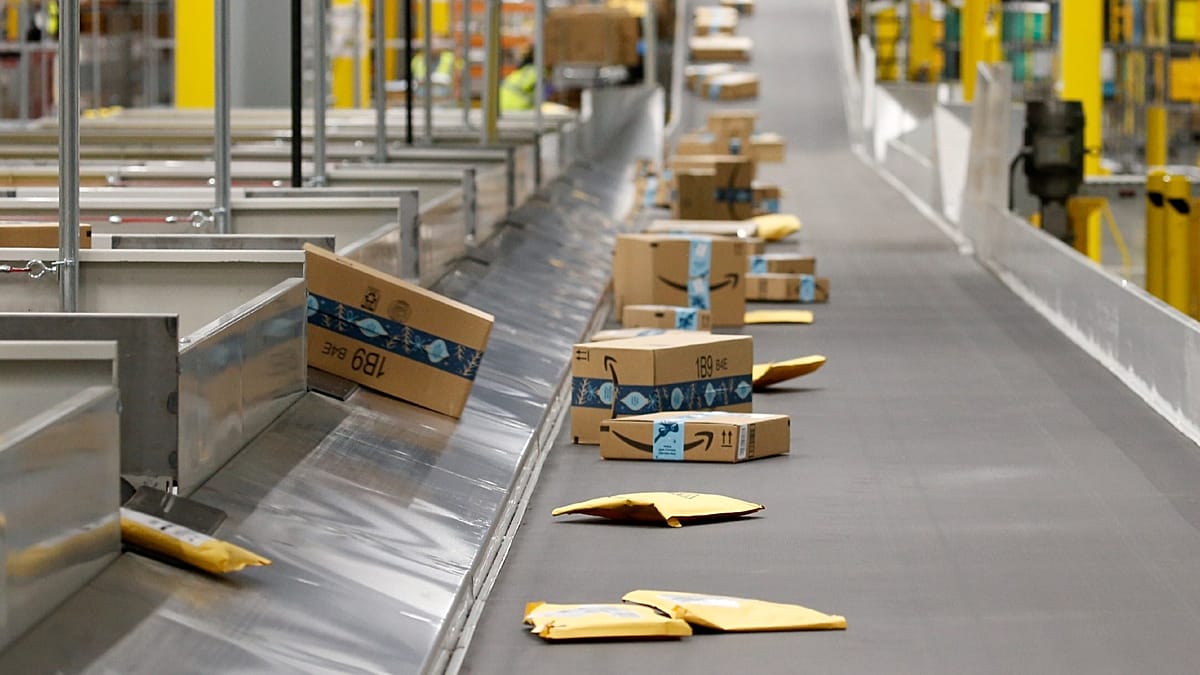
On 1 July, the European Commission introduced a temporary €3 customs handling duty on low-value parcels entering the EU from outside the bloc. The measure applies to each item type worth up to €150 purchased online and shipped directly to consumers.
The Commission says the duty is intended to create fairer competition for European businesses while helping to cover the cost of processing the growing number of low-value imports. The measure will remain in force until 1 July 2028, when it is expected to be replaced as part of the EU’s wider customs reform.
The announcement quickly sparked debate online, with some users arguing that consumers will ultimately end up paying more.
In a post on X, the European Commission said the duty is charged to e-commerce platforms, not directly to shoppers.
A European Commission spokesperson also told Euronews’ fact-checking team, The Cube, that “consumers buying online are not legally responsible for paying the duty”.
However, the spokesperson added that the Commission “cannot speak for sellers or platforms on how they will absorb this cost.”
Experts told us that, in practice, costs do indeed end up falling on customers even if it’s the companies that are legally responsible for paying them.
The reform’s practical impact
Businesses rarely absorb additional costs in full, according to Olivia Brown, a policy officer at the consumer organisation Euroconsumers.
Instead, they often pass at least part of the extra expense on to consumers through higher prices or additional charges.
“In reality, what we see is that when a cost is added anywhere in the supply chain, it very rarely just disappears into a company’s margin,” Brown said. “It often ends up being reflected in the price consumers pay.”
To test the claim, we ordered a product on Amazon from outside the EU for delivery to Belgium. At checkout, the platform applied a €3 “import charges” fee linked to the new EU customs duty.
The duty is not charged per order but for each type of goods, based on its customs tariff classification. This means the total cost depends on what is being purchased.
For example, if a customer orders two T-shirts, a phone and a watch, the €3 duty can be applied three times because the products fall under three different customs tariff classifications, bringing the total import charges to €9, on top of VAT.
Limited impact
Some platforms are limiting the impact of the new rules by shipping products from warehouses already located within the EU. In those cases, the €3 duty does not apply because the goods are no longer entering the EU customs territory directly from outside the bloc.
In 2025, 97% of products ordered on Amazon through its EU stores were dispatched from within the EU and would therefore not be affected by the new customs duty.
Using European warehouses has also become a way for platforms to avoid the new levy on direct-to-consumer imports. China tech analyst Ed Sander told The Cube that companies such as Temu had been preparing for the change well before it came into force.
“Temu has been preparing for this for quite a long time,” Sander said. “As early as 2024, it started encouraging merchants to store goods in European warehouses, with sellers taking responsibility for the logistics.”
“Not every merchant wanted to do that because it ties up capital and creates inventory risks if products do not sell,” he added. “So Temu also started stocking goods itself in local warehouses.”
According to Sander, Temu’s goal was for around 80% of the goods sold in Europe to be stored in local warehouses by the end of 2025.
“If goods are stored in local warehouses, they are imported in bulk by sea rather than shipped individually by air directly to consumers,” he said. “That means they are imported at wholesale values rather than the retail value of individual parcels, significantly reducing the costs associated with direct-to-consumer imports.”
Sander said that, regardless of who is legally responsible for paying the duty, consumers are still likely to bear at least part of the additional cost.
“Ultimately, consumers always end up paying. Either they pay the import duty directly, or sellers build the extra cost into their prices,” he explained. “In some cases, platforms may share the cost between themselves, merchants and consumers, but consumers still end up paying at least part of it.”
Read the full article here