


Ukraine is demanding a long-term ceasefire in Russia’s all-out war instead of the short parade-day truce the Kremlin floated to US President Donald Trump, as Kyiv accused Moscow of seeking a few hours of quiet to protect a military parade rather than pursuing genuine peace.
Ukrainian President Volodymyr Zelenskyy said on Thursday that Kyiv would first see “what exactly is this about,” in response to the proposal that came on Wednesday evening after Russian President Vladimir Putin suggested a temporary truce in a phone call with Trump.
“We will clarify what exactly this is about — a few hours of security for a parade in Moscow or something more,” Zelenskyy wrote in a post on X.
“Our proposal is a long-term ceasefire, reliable and guaranteed security for people, and a lasting peace,” Ukraine’s president said, adding he instructed Kyiv negotiators to contact the US side for more details.
Moscow insists that the Victory Day parade proposal is coming from the Kremlin.
Putin’s press secretary said on Thursday that the specific dates for the ceasefire will be announced separately.
Dmitry Peskov said that Trump “actively backed the initiative, noting that the holiday marks the shared victory over Nazism in the Second World War.”
Moscow proposal was communicated only to the US administration as Russian officials are still refusing any contact with Kyiv.
Parade in Moscow with no tanks
Russia previously announced a short ceasefire for Easter earlier in April. For Russian authorities, Victory Day has the same symbolic meaning.
More than a victory fete, 9 May for Russia under Putin has become one of the most important holidays and a public demonstration of the Kremlin’s military power.
This year the show will be significantly scaled back, according to Moscow.
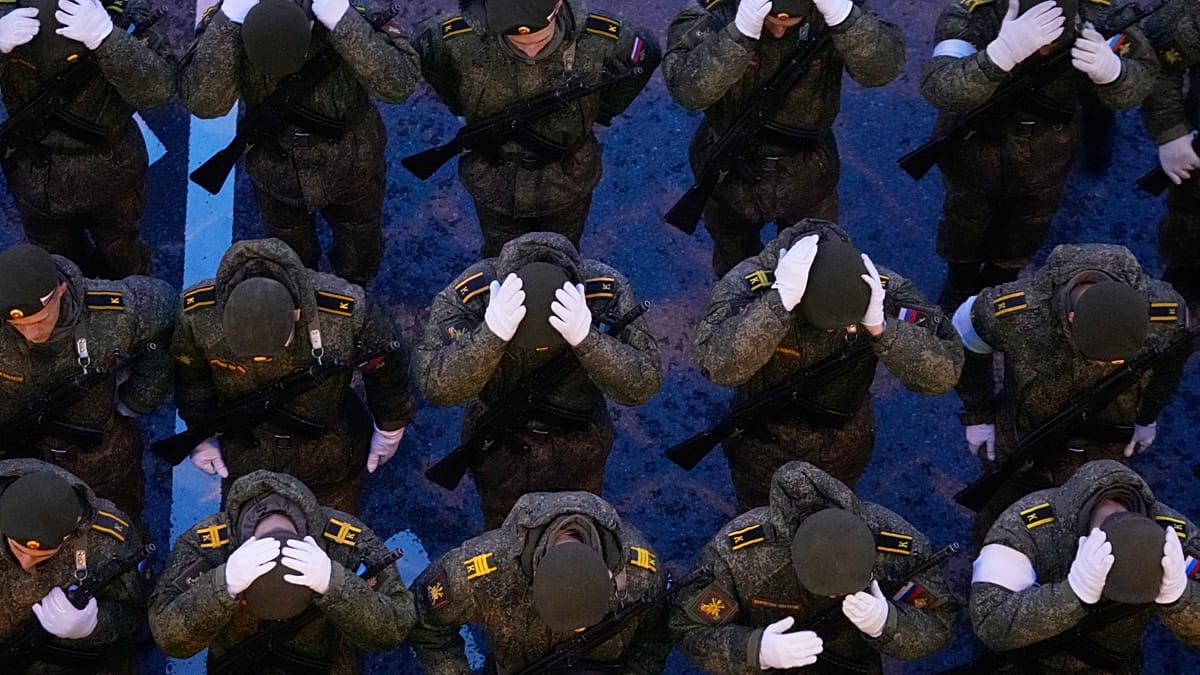
The Victory Day parade would not feature military vehicles or cadets due to what the Kremlin described as “current operational situation”.
“All measures are being taken to minimise the danger,” Putin’s spokesperson Dmitry Peskov said earlier as he referred to what Moscow called a “terrorist threat” from Ukraine.
But the fact that the parade is scaled down is seen as an important indicator of the situation in Russia’s military and of personnel and equipment shortages.
The Victory Day parade has become even more symbolic for the Kremlin since the beginning of Russia’s full-scale invasion of Ukraine in early 2022, as Moscow has been using the imagery and narratives of World War II to back its war.
In its war against Ukraine, Russia has rehashed a slew of slogans and symbols identical to the ones the Soviet Union used in WWII such as “We can do it again” or “We can repeat it,” now widely used by Russian soldiers in Ukraine.
Similarly, the orange-black St George’s Ribbon, which used to symbolise the WWII victory, has now become one of the most recognisable emblems of Russia’s full-scale invasion of Ukraine and is worn by the supporters of Moscow’s attack on the neighbouring country.
Moscow has linked the two narratives through language as well, using elaborate phrasing to create a substitute term implying grandeur: for example, calling its full-scale invasion of Ukraine “a special military operation,” in the same way it refers to WWII as the “Great Patriotic War”.
Putin himself has repeatedly claimed that “the Soviet people were fighting alone” in WWII, minimising the contribution of the Allies.
On the eve of the full-scale invasion of Ukraine in February 2022, Putin stated its primary goals were the “denazification” of the country and the “fight against fascism” — claims Moscow never backed up with evidence.
The popularisation of this rhetoric and Putin’s glorification of Victory Day have their own term in Russian: “pobedobesie,” a derogatory word meaning grotesque hyperbolic celebrations, or “victorymania”.
Ukraine has distanced itself from Soviet-era commemorations and dates. Zelenskyy signed a law in 2023 that moved Ukraine’s WWII remembrance to 8 May, aligning it with most of Europe.
Then part of the Soviet Union, Ukraine suffered some of the heaviest losses of any constituent republic in WWII, with estimates of Ukrainian casualties ranging from 6 to 8 million, including both soldiers and civilians killed in fighting, occupation and Nazi extermination campaigns.
Read the full article here