


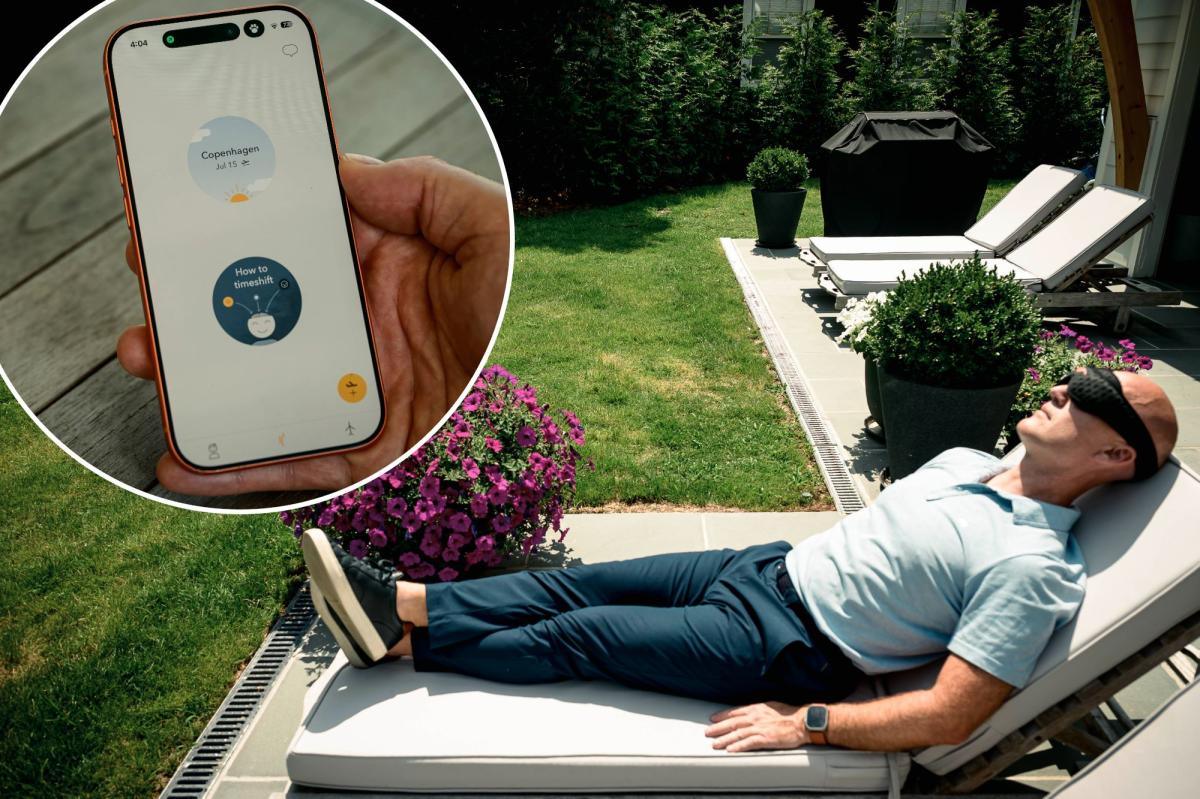
A well-traveled Long Island man is on a mission to make jet lag a thing of the past — and his NASA-used technology is so popular that even World Cup teams such as England and France have relied on the app to stay energized.
Mickey Beyer-Clausen, the son of a flight attendant, built his Timeshifter app for travelers such as himself to input their sleep preferences easily, then receive a readout of when to stay awake, snooze and even consume caffeine for energy while adapting to a time zone.
“The whole body is struggling and misaligned, the Southampton resident said of the switch-over to different time zones.
“Food, special diets, exercise, hydration — much of the advice that we hear out there simply does not work.”
For one thing, jet lag can’t just be slept off, said Beyer-Clausen, 51, who was born in a fishing village north of Copenhagen, Denmark.
“It has no scientific evidence behind it,” he said of the popular supposed remedy.
His 2018-launched app was co-founded by NASA-tied Harvard Medical School scientist Dr. Steven Lockley — and based on technology that helped astronauts sleep properly onboard the International Space Station.
A core part of the app — the most popular of its kind with nearly 2 million subscribers — is guiding travelers on the exact amount of time and which hours of the day they should spend in bright or dark environments to keep up with their typical routine.
“That is the most powerful signal we can send to the body to manipulate, shift, and control adjusting quicker to the new time zone,” he said.
Beyer-Clausen said dark sunglasses are the “No. 1” carry-on item so travelers always have a way to simulate dark environments when needed — even if it means wearing them on a bright plane or indoors.
Timeshifter also hand-tailors its guidance based on an individual’s sleep preferences and peak energy times, a pattern known as a person’s chronotype, including by changing slumber patterns in the days leading up to a trip.
There is no one-size-fits-all approach to beating jet lag, as each person’s chronotype greatly varies, but early birds typically do better while traveling east and night owls west, Beyer-Clausen said.
Lufthansa embraced the value in Timeshifter when more than 150 of its employees downloaded the app, leading to a partnership between the two.
Nike recently also rolled out a collaboration offering it to its sponsored athletes on the World Cup teams from France, England, Brazil, Norway, the Netherlands and even Team USA playing on home turf.
Some top tennis players and Formula 1 racers, along with MLB and NBA teams, have also taken great interest in Timeshifter’s technology for sports science purposes, he said.
“When we work with a team, they’re curious what games are problematic for them,” Beyer-Clausen said.
“We can just outline them and say, ‘Here you have a 74% chance of losing or winning based on circadian rhythm.”
Timeshifter, which will be used again by Nike for the 2028 Olympic Games in Los Angeles, is poised to make much more noise — and big bucks — in the sports scene as reliable data continues to emerge.
“I can tell you that the revenue I budgeted for 2026 in terms of the concierge services we do for athletes — I reached that on the 15th of January this year,” Beyer-Clausen said.
Read the full article here