


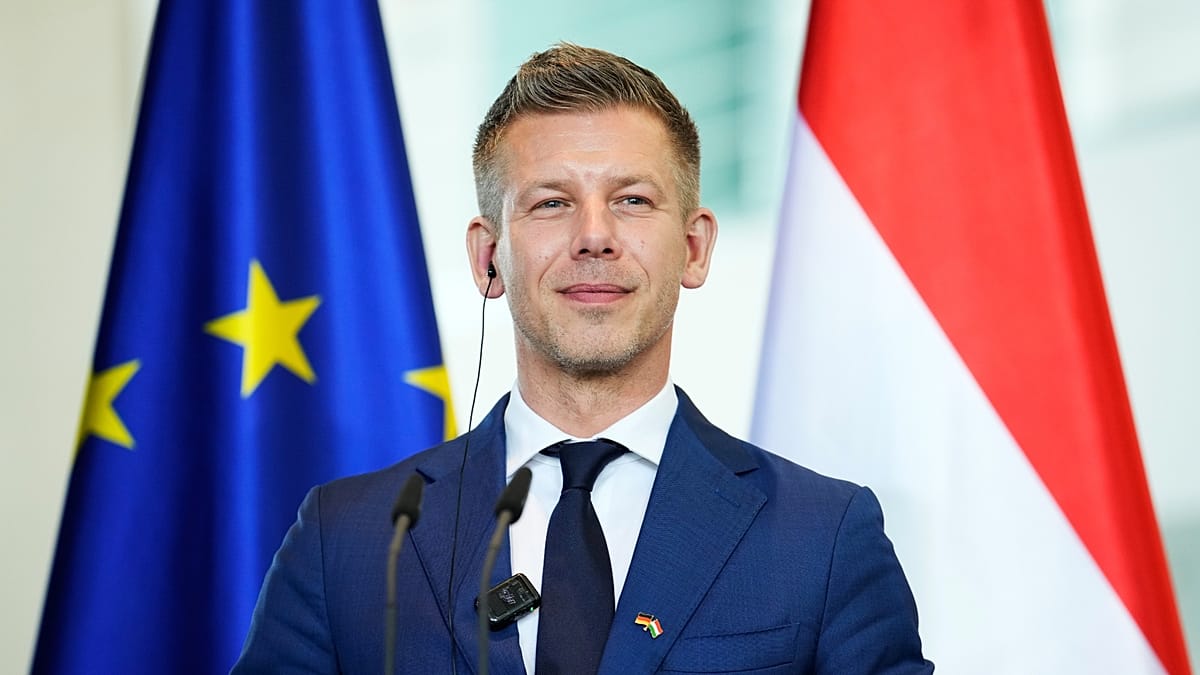
Prime Minister Peter Magyar has signalled an imminent deal with Kyiv to safeguard the rights of Hungarian minorities in Ukraine, raising prospects for an agreement that could finally unlock EU accession talks after months of political deadlock.
Speaking to reporters in Berlin following a bilateral meeting with German Chancellor Friedrich Merz, Magyar said he was “very optimistic” about resolving the long-standing issue of Hungarian minorities in Ukraine — a delicate political matter — and pointed to a resolution on a technical level “as soon as this week”.
“The negotiations are progressing encouragingly,” he said. “I am ready to meet with Ukraine’s president at the beginning of next week, if we manage to agree on these fundamental human rights.”
His comments come after five diplomats briefed on the matter told Euronews that conditions for a deal have gained momentum, potentially allowing Hungary to lift its veto on Ukraine’s accession talks by 16 June.
The decision carries significant weight: it would end months of impasse for Ukraine, signal a new chapter in diplomatic relations between Kyiv and Budapest, and simultaneously advance Moldova’s bid — with the two candidacies widely viewed as a package in EU circles.
A document seen by Euronews, drafting conclusions for the upcoming EU leaders’ summit, references Ukraine’s bid to join the European Union, signalling that a breakthrough is possible before the 27 member states convene on 18 June.
If endorsed, the text would mark a return to unanimity on Ukraine following the departure of Viktor Orbán.
“The European Union remains committed, including as part of Ukraine’s path to EU accession, to supporting its repair, recovery and reconstruction, in coordination with international partners,” the draft statement, dated 1 June and seen by Euronews, reads.
An EU official told Euronews the next European Council is being prepared “under the assumption that this issue will settled”.
The draft also notes that Ukrainian President Volodymyr Zelenskyy is expected to attend the summit, though it does not specify whether he will participate in person or via conference. Ukrainian sources told Euronews that Zelenskyy would only consider travelling to Brussels if a deal was within reach.
European Council President António Costa has been heavily involved in the talks, according to people familiar with the matter. Marta Kos, the Commissioner responsible for EU enlargement, is also growing confident that a deadline to open the first cluster of negotiations in June, to be followed by five additional clusters in July, is possible.
Adding to the positive momentum, Magyar last Friday secured the release of €16.4 billion in EU funding following a meeting with European Commission President Ursula von der Leyen.
Although he rejected suggestions that the funding and enlargement discussions were linked, Magyar said at the press conference that he was waiting for “guarantees” from Ukraine on minority rights, indicating that legislative changes might not be necessary.
Lifting Hungary’s veto is a prerequisite for opening the first accession cluster, which covers the fundamentals of EU membership — including the rule of law, financial controls, and fundamental rights.
“We are making every effort to achieve a breakthrough, and we are focused on moving both countries forward,” a senior EU diplomatic source told Euronews, cautioning that it was still too early to predict the final wording of the leaders’ statement.
Ahead of the summit, EU officials hope to formally launch the next stage of the enlargement process at the General Affairs Council on 16 June. The matter can be handled can by handled by diplomats, although a meeting between Magyar and Zelenskyy is also seen as necessary to open a new political entente.
However, significant technical work still needs to be completed and approved by member states’ ambassadors before that can happen. The Council would need to initiate the process by sending a letter to Ukraine and Moldova, which would then respond with their positions for European ambassadors to assess.
Only after that would Hungary be in a position to lift its veto.
“Everybody needs to move fast,” a senior EU diplomat added.
With assistance from Jorge Liboreiro and Sasha Vakulina
Read the full article here