


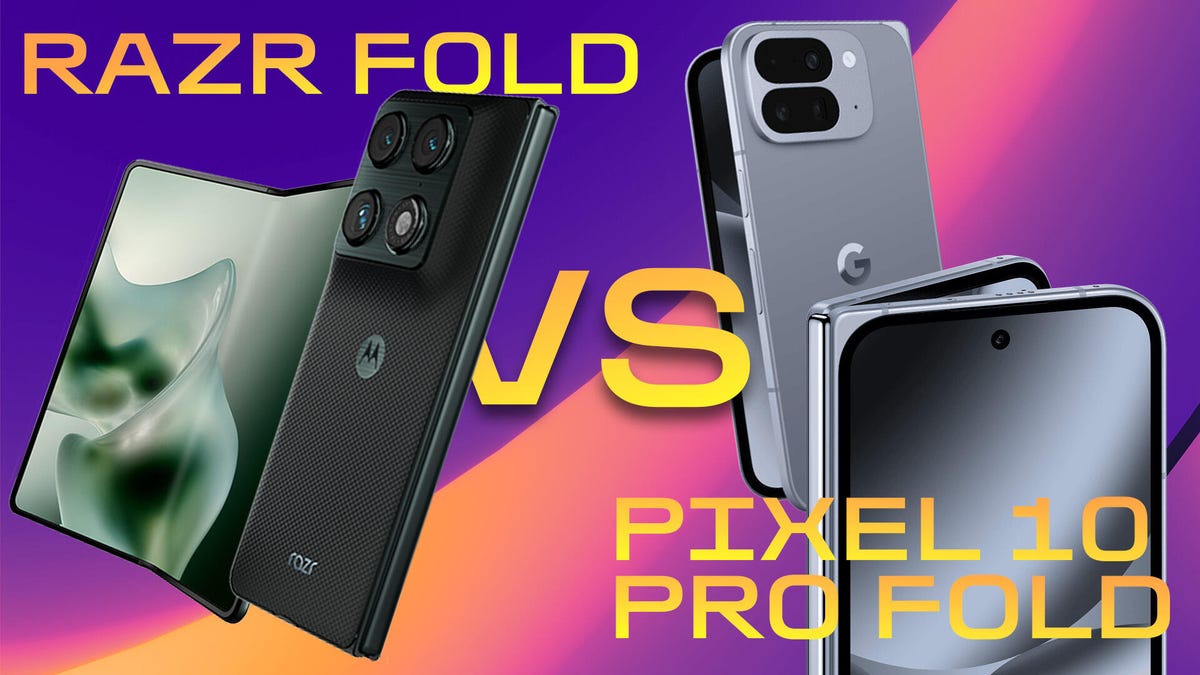
The foldable phone space is ushering in a new player: the Motorola Razr Fold. As the company’s first book-style handset, it’s slated to give other gadgets a run for their money as competition heats up.
That includes Google’s Pixel 10 Pro Fold, which debuted in the fall. As one of the more robust foldable phones with an IP68 rating for dust and water resistance, the Pixel 10 Pro Fold boasts a fresh design without compromising on durability.
The Razr Fold offers a more fashion-forward approach, with a slightly thinner design than the Pixel 10 Pro Fold and vegan leather finishes on the back. It has IP48 and IP49 ratings, meaning it can withstand being submerged in water for 30 minutes as well as high-pressure water jets, but can’t handle dust and small particles.
The Razr Fold clocks in at around 4.6mm thick when open and 9.9mm thick when closed, while the Pixel 10 Pro Fold is 5.2mm thick when open and 10.8mm thick when closed.
Both phones come with a hefty price. The Razr Fold starts at $1,900 for 512GB of storage, while the Pixel 10 Pro Fold starts at $1,799 for 256GB.
In the US, preorders for the Razr Fold begin May 14 at Best Buy and Motorola’s site, with availability starting May 21. It’ll also be sold through Verizon, T-Mobile and Xfinity Mobile in the coming months.
Here’s how the Razr Fold stacks up against the Pixel 10 Pro Fold.
Razr Fold vs. Pixel 10 Pro Fold displays
The Razr Fold is just slightly bigger than the Pixel 10 Pro Fold. It has a 6.6-inch cover display with a 165Hz variable refresh rate, and an 8.1-inch internal display with a 120Hz variable refresh rate.
The Pixel 10 Pro Fold has a 6.4-inch cover display with a 60Hz to 120Hz refresh rate. The internal display is 8 inches, with a 1Hz to 120Hz refresh rate.
The Razr Fold has a whopping 6,000-nit peak brightness for the external display and a 6,200-nit peak brightness for the main display. That’s twice the 3,000-nit peak brightness of the Pixel 10 Pro Fold’s cover and main displays. We’ll have to wait to see how much of a difference that makes in the bright outdoors.
I can spot the creases on the main displays of both phones, but they’re not obtrusive, especially when I’m using the devices.
If you like the option of using a stylus, the Razr Fold supports the Moto Pen stylus — which sells separately for $100. There isn’t a similar capability for the Pixel 10 Pro Fold.
Razr Fold vs. Pixel 10 Pro Fold cameras
The Razr Fold has a triple 50-megapixel rear camera system with wide, ultrawide and telephoto lenses. There’s a 20-megapixel selfie camera on the inner screen and a 32-megapixel one on the cover screen.
The Pixel 10 Pro Fold has a 48-megapixel wide-angle, 10.5-megapixel ultrawide and 10.8-megapixel telephoto camera. There are also 10-megapixel selfie cameras on the inner and cover screens.
I look forward to snapping pictures with the Razr Fold to see how those specs translate in the real world.
Razr Fold vs. Pixel 10 Pro Fold batteries
The Razr Fold’s 6,000-mAh battery is one of its biggest flexes. Hopefully, that’ll allow the phone to last well beyond a day. It supports 80-watt wired charging and 50-watt wireless charging, along with 5-watt reverse wireless charging.
The Pixel 10 Pro Fold has a 5,015-mAh battery, which in my testing held up over a day with regular use. It supports up to 30-watt wired charging and can charge wirelessly at 15 watts. It’s also Qi2 certified to work with wireless chargers and accessories supporting that standard.
Razr Fold vs. Pixel 10 Pro Fold processor and storage
The Razr Fold is powered by a Snapdragon 8 Gen 5 processor, while the Pixel 10 Pro Fold is powered by Google’s Tensor G5 processor. These are built to handle the slew of AI features on both phones, as well as heavy use cases like shooting and editing video or gaming.
The Razr Fold comes with 16GB of RAM and 512GB of storage. The Pixel 10 Pro Fold comes with 16GB of RAM with either 256GB, 512GB or 1TB of storage.
Both phones arrive with Android 16 out of the box. The Pixel 10 Pro Fold comes with seven years of software and security updates, and Motorola similarly supports “7 OS updates and up to 7 years of security updates starting from the global launch date,” according to its website.
Which phone is right for you?
The Motorola Razr Fold and Pixel 10 Pro Fold may not vary drastically in their overall designs and dimensions, but there are slight differences across key categories, at least on paper. We have yet to test the Razr Fold’s cameras and battery life, but based on our brief hands-on experience, it appears to be a promising phone for anyone looking for a fresh, premium design.
Neither phone is as thin as the Galaxy Z Fold 7 or the Honor Magic V6, but neither is prohibitively thick. Google’s biggest flex with the Pixel 10 Pro Fold is its durability and IP68 rating, while Motorola has been touting the large battery capacity on its book-style foldable. We’ll have to see how the Razr Fold holds up in our testing, so stay tuned for more hands-on insights in our upcoming review.
Read the full article here