


Launched on June 1 at Computex 2026 with a handful of big-name laptop partners, Nvidia’s RTX Spark N1X designed-for-AI chips are still lacking any notable details beyond the basics. Only that there are two versions: a 20-CPU-core and 6,144-GPU-core version for laptops and desktops — which supports up to 128GB unified memory — and one with 18 CPU cores and 5,120 GPU cores — which supports only up to 32GB memory — that’s designated for laptops. But we do now have more precise availability information than “fall”: It’s expected next month, in October.
It strikes me as a bit odd that the 18-core version maxes out at only 32GB RAM, especially since it’s shared between the CPU and GPU. It seems like an awfully powerful chip that could potentially become bottlenecked by memory. On the other hand, that could be a power or space constraint, since it’s intended for light, thin laptop designs. But these are intended to be power systems — mainstream workstations, really — for AI and gaming.
As with all hardware announcements these days, there’s no pricing info available yet. Component cost volatility is driven by shortages caused by large-scale demand for AI silicon from data centers, which compete for chip and memory manufacturing and packaging resources. Nvidia is partly responsible, since it’s one of the biggest companies driving these installations.
So it’s anyone’s guess, even as close to shipping as we are, what the prices of these premium models will be. My fellow hardware sheriff Josh Goldman summarized the conundrum succinctly: “Workstation performance in a smaller, thinner, lighter package that no one can buy ’cause the costs are too high. Nvidia has dug itself an affordability hole it can’t get out of.”
Hardware’s coming
While I don’t expect it to lag behind existing competitors, take its performance claims with a grain of salt. In this case, Nvidia blithely says the Spark has a “1 petaflop GPU.” But that’s for its NVFP4 data type. FP4 is a low-precision type optimized for efficiency, meaning it prioritizes speed and low memory overhead over accuracy compared with higher-precision formats such as FP16 or FP32, which are also more common as a basis for comparison –especially since, as far as I can tell, no prosumer integrated GPUs support FP4 natively. The disadvantage of FP4 is that it’s more likely to experience rounding errors than the higher precision formats. In practice, that can mean, for example, lower detail or less variety during local image generation. (Procyon has a great visual example of what speed versus accuracy tradeoffs can mean for image generation.)
Lenovo was one of the announced partners at launch, with its Yoga Pro 9n and Yoga 9n two-in-one, but at IFA, there were more concrete details and models to show. Unlike the Microsoft Surface Laptop Ultra, which has a MiniLED backlit IPS display, the Lenovo models incorporate the reference design recommendation of Tandem OLED screens.
| Yoga Pro 9n | Yoga 9n 2-in-1 | |
|---|---|---|
| Display size/resolution | 15.3-inch, 2,560×1,600-pixel OLED, touchscreen option, 100% P3, DisplayHDR True Black 1000, 165Hz | 16-inch, 2,880×1,800-pixel OLED, touchscreen, 100% P3, DisplayHDR True Black 1000, 120Hz |
| CPU | Nvidia RTX Spark 18C or 20C | Nvidia RTX Spark 18C or 20C |
| Memory | Up to 128GB LPDDRX-9400 | Up to 32GB LPDDRX-9400 |
| Graphics | Integrated 5,120C or 6,144C | Integrated 5,120C or 6,144C |
| Storage | Up to 4TB, 2 M.2 2242 SSD slots, SD slot | Up to 2TB, 2 M.2 2242 SSD slots, SD slot |
| Ports | USB-C x 2 (USB4), USB-A x 2, combo audio, HDMI 2.1 | USB-C x 2 (USB4), USB-A x 2, combo audio, HDMI 2.1 |
| Networking | Wi-Fi 7, Bluetooth 5.4 | Wi-Fi 7, Bluetooth 5.4 |
| Operating system | Windows 11 | Windows 11 |
| Weight | 3.6 pounds/1.7 kg | 3.6 pounds/1.7 kg |
Previously announced laptops include:
- Dell XPS 16
- Asus ProArt P14 and P16
- HP Omnibook X 14, Omnibook Ultra 16
- MSI Prestige N16 Flip AI
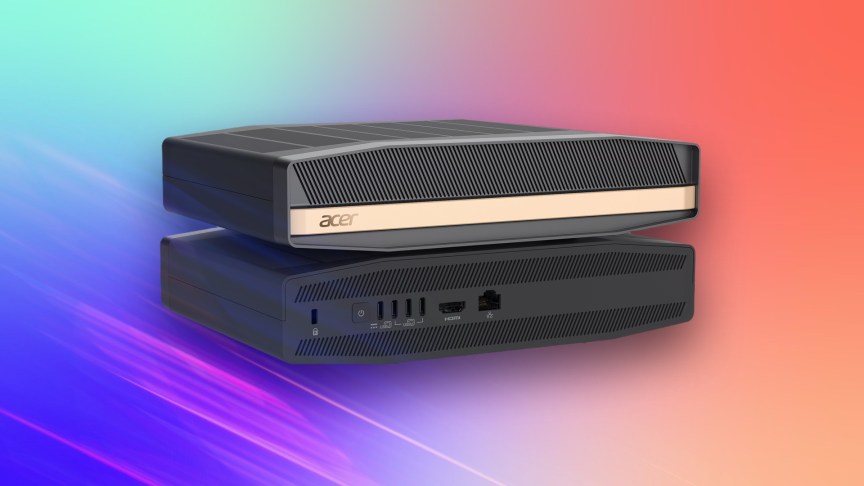
At IFA, Acer also announced that it’s planning some kind of small PC based on the Spark at some point in the future. Whenever.

See full bio
Read the full article here