


What’s motivating smartphone owners to consider upgrading hasn’t changed much over the years.
Zain Awais/CNET
Charging your phone in the middle of the day can be annoying and inconvenient, especially when you’re on the go. Instead of fumbling with chargers, how about more battery life for your smartphone?
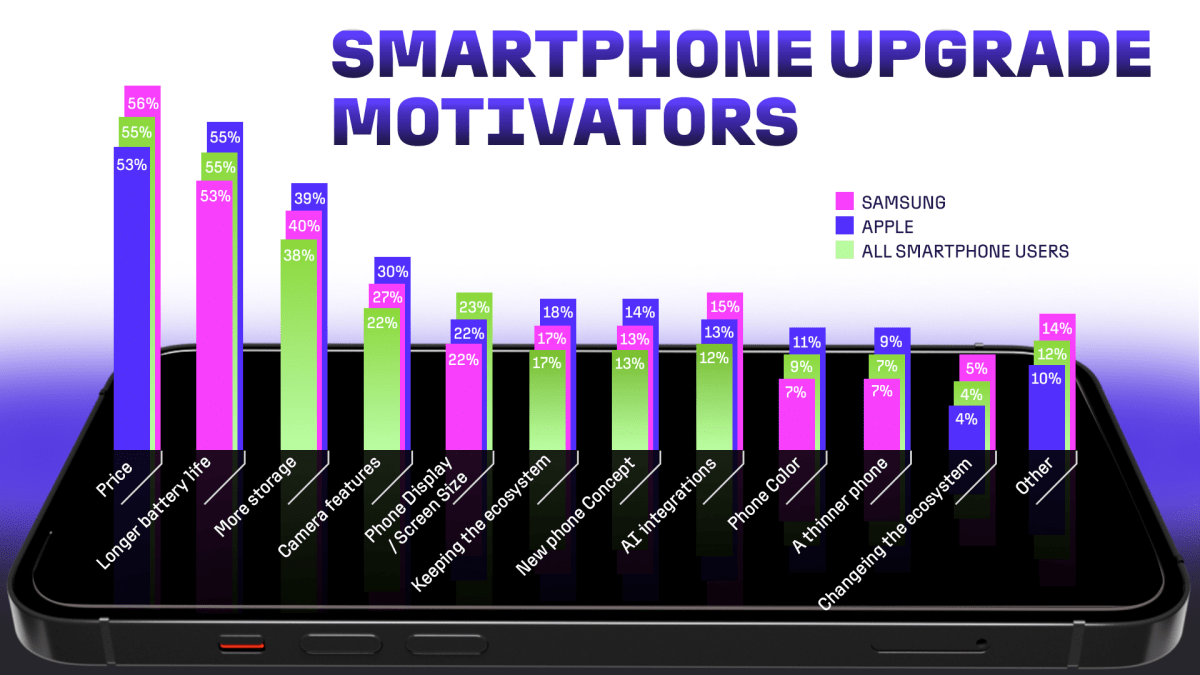
That’s what’s driving 52% of US adults to consider upgrading their phone according to a CNET survey. Besides that, 55% say a better price would convince them to get a new phone. With Apple’s Surprise and Shine event planned for Wednesday, Sept. 9, we’re expecting Apple’s first foldable phone and two phones from the iPhone 18 series. Analysts say the iPhone Ultra, iPhone 18 Pro and Pro Max could have better battery life than older models. But don’t expect lower prices thanks to RAMageddon.
With Apple’s event just days away, here’s what US adults are looking for in a smartphone and how it may be able to deliver.
Key findings
- The top three motivations for US adult smartphone owners to consider upgrading their devices are price (55%), longer battery life (52%) and more storage (38%). That’s the same top three as last year: In 2025, price was the top motivator (62%), followed by longer battery life (54%) and storage capacity (39%).
- Despite AI’s growing presence, only 12% of smartphone owners say AI integrations would motivate them to consider upgrading.
- Only 13% of smartphone owners would be motivated to consider upgrading to a new phone concept, such as a foldable or flip phone.
- Over half of smartphone owners (58%) experience frustration with their phone’s battery life, and 31% say their phone’s battery doesn’t hold a charge as well as it did when it was new.
Most US adults aren’t motivated by new smartphone features and designs
Smartphone brands, like Samsung and Apple, are building in convenient features, such as a tool to remove unwanted objects from pictures, AI call screening and the ability to draft a message from a prompt. However, CNET found that US adults would consider upgrading for more practical reasons. Over half (55%) of US smartphone users are motivated by price, including 53% of Apple users and 56% of Samsung users.
Yet brands are still exploring new concepts and features, like Apple Intelligence, a built-in AI feature and even Siri AI which will debut with iOS 27. Analysts expect Apple to unveil a book-style foldable iPhone, which could be named the iPhone Ultra or iPhone Fold. But that’s not what most smartphone owners are after.
Smartphone owners are more convinced by other design and feature factors when deciding on a new phone, such as camera features (27%) and the phone’s display or screen size (22%). Here are the top motivators to consider upgrading for all smartphone users.
You’ve probably noticed the price of a basic smartphone has increased drastically over the years and now there’s a rumor that the price for the iPhone 18 series could be higher at Wednesday’s event. A TrendForce analyst predicts that the iPhone 18 Pro could start between $1,199 and $1,299, and $1,299 to $1,399 for the iPhone 18 Pro Max. Meanwhile, the iPhone Ultra could start between $2,099 and $2,299.
Higher prices may be a good reason to buy the iPhone 17 now if you see a good deal, especially if Apple doesn’t release the base model of the iPhone 18 next week.
The top upgrading motivators haven’t changed much over the years
Looking back at CNET’s survey data from 2024 and 2025, and now, people’s motivators for upgrading their phones haven’t changed much. Price, longer battery life and more storage have been top drivers in the past, and despite small dips this year, they’re still key upgrading factors.
Despite design upgrades and new features, smartphone owners are still focused on how much they’re paying and how long they can use their devices without needing a charger. Consumer sentiment about AI integrations dropped hard from 2024 to 2025, but it has edged up slightly in 2026. And smartphone owners aren’t as easily persuaded by phone color or the phone being thinner, either.
Even with these nice-to-have capabilities, smartphone owners are looking at the basics. That includes practical features like battery life and more storage to hold their many important files, photos and apps.

Most smartphone owners want better battery life
Taking a closer look at smartphone users’ hope for longer battery life in a new phone, over half (58%) are frustrated with their current phone’s battery life. Roughly 1 in 3 (31%) say their phone doesn’t hold a charge.
The reality is, battery life will decline the longer you have your phone, so you may find your phone’s battery charge doesn’t last as long as it used to. Even though you can replace your phone’s battery, most phone batteries have a lifespan of two to three years before they start degrading.
CNET Director of Editorial Content Patrick Holland examined battery life tests on over 35 current smartphones. And it’s not just iPhones that pack impressive batteries.
Phone Batteries Are Better Than Ever. Why Doesn’t It Feel That Way?
Based on CNET’s lab testing, the $1,200 iPhone 17 Pro Max had the best overall battery life, with a 5,088-mAh capacity. Another top performer was the $900 OnePlus 15, with a 7,300-mAh battery. There’s a rumor that if Apple releases a foldable phone in the future, it will be even better than the iPhone 17 Pro Max, but we’ll have to wait and see.
If you’re looking for a phone with better battery life, consider one with a silicon-carbon battery to increase capacity without requiring a larger phone. The OnePlus 15, Poco F7 Ultra, OnePlus 13R and OnePlus 15R all feature silicon-carbon batteries with large capacities and all performed well in Holland’s testing. Keep in mind that other factors can impact your battery life, like your carrier’s signal, software efficiency and processor.

Methodology
CNET commissioned YouGov Plc to conduct the survey. All figures, unless otherwise stated, are from YouGov Plc. The total sample comprised 2,486 adults, of whom 2,407 owned a smartphone. Fieldwork was undertaken from April 29 to May 1, 2026. The survey was carried out online. The figures have been weighted and are representative of all US adults (aged 18 plus).

See full bio
Read the full article here