


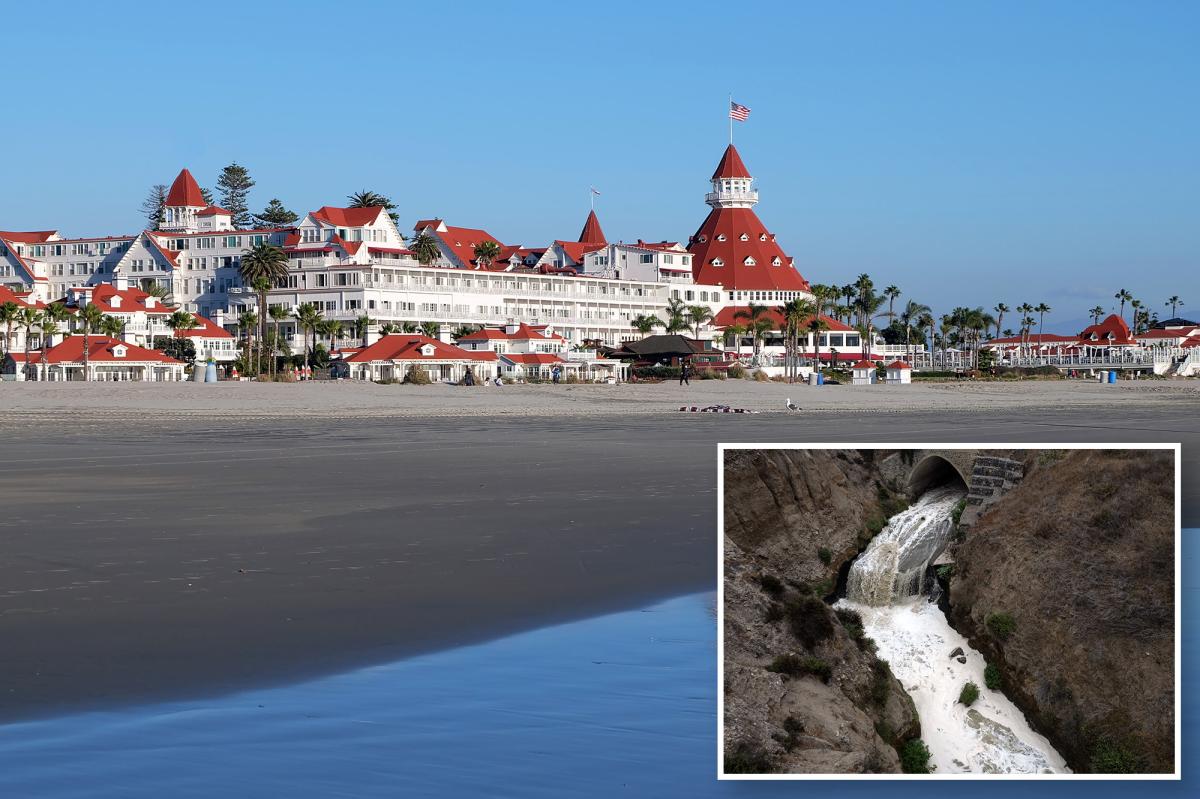
Millions of gallons of sewage-tainted water from Mexico continue to pollute some of Southern California’s most popular beaches, triggering repeated closures and mounting health concerns for nearby communities.
In Coronado, county officials have sounded the alarm, urging visitors to steer clear of the water as polluted runoff seeps into the coastline.
Warning signs posted along the shoreline caution beachgoers that exposure could lead to illness.
The contamination is largely tied to the Tijuana River, which carries untreated wastewater from Mexico into U.S. waters before ocean currents push the pollution north along the Southern California coast.
As much as 30 million gallons of sewage-tainted water can flow into the Pacific Ocean daily from Tijuana, reported FOX11.
The pollution has impacted even some of the region’s most high-profile beachfront areas, including waters near the historic Hotel del Coronado.
Health experts warn that exposure to contaminated water can cause gastrointestinal illness, while airborne toxins linked to sewage pollution may trigger headaches, respiratory issues, and other health problems.
Hydrogen sulfide, a gas associated with sewage, can irritate the eyes and respiratory system and may cause more serious effects at higher concentrations, according to the Centers for Disease Control and Prevention.
Doctors and community advocates say children in affected communities have been especially impacted, with some reporting worsening asthma symptoms, skin rashes, and other health issues tied to the pollution.
The crisis has dealt a blow to tourism and even thrown military routines into disarray, as local leaders warn that polluted waters have hampered Navy SEAL training at the Naval Amphibious Base Coronado.
President Donald Trump has called on Mexico to address the ongoing flow of untreated wastewater entering the United States, describing it as a threat to nearby communities.
In February, U.S. Environmental Protection Agency (EPA) Administrator Lee Zeldin provided a public update on the Trump Administration efforts to permanently end the Tijuana River Sewage Crisis.
“The Trump EPA has been working every day at implementing the permanent, urgent 100% solution to the decades old Tijuana River raw sewage emergency,” he said.
“The agreement we signed with Mexico last year includes reduced timelines and additional necessary Mexico-side projects at no added US taxpayer cost … As these projects are completed in 2026 and 2027, with one project slated for 2028, Americans will be finally crossing the long-awaited finish line of this crisis and nightmare,” Zeldin added.
The United States and Mexico signed an agreement in July 2025 outlining specific steps and a new timetable to clean up the longstanding problem of the Tijuana River.
“There is a great commitment by the two countries to strengthen cooperation,” Mexico’s Environmental Secretary Alicia Bárcena said after meeting with Zeldin in Mexico City for the signing of the memorandum of understanding.
Under the agreement, Mexico would complete its allocation of $93 million toward infrastructure projects, including adhering to a specific schedule for priority projects spanning through 2027.
Since 2020, more than $653 million in funds have been allocated to address the issue, but the crisis has continued largely because of delays by the Mexican government, Zeldin has said.
The agreement reportedly factors in “population growth, operation and maintenance costs, and other variables that would make this solution durable and long-term.”
Read the full article here