


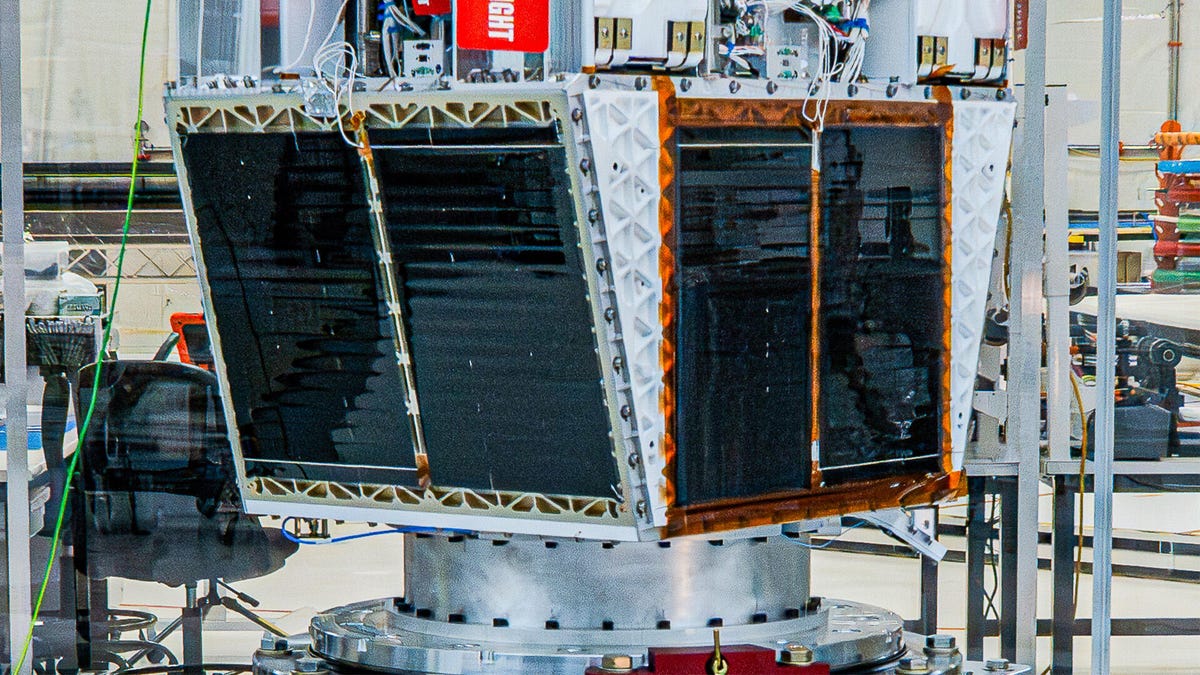
When humans mess with the sun in science fiction, it’s usually when a supervillain covers it up and imposes permanent darkness. A space tech company called Reflect Orbital wants to do the opposite: bring sunlight to the dark side of Earth with satellites equipped with giant mirrors. The FCC approved a single satellite as a test demonstration on Thursday, and some scientists are already unhappy about it.
The approval green-lights Reflect Orbital to send its Eärendil-1 satellite into orbit. It’s a relatively small spacecraft, weighing 142 kilograms (313 pounds).
Housed in its body is a thin-film square mirror measuring 18 meters by 18 meters (about 60 feet by 60 feet). The satellite is scheduled to launch into space on a SpaceX Falcon 9 later in 2026.
Eärendil-1 promises to reflect sunlight onto Earth in a 3-mile circle that can be aimed basically anywhere that doesn’t have sunlight. The company has a web tool that shows you what this would look like, and it’s wide enough to light up entire neighborhoods, making it appear like daytime when it’s actually night.
Earendil-1 is able to reflect sunlight down to a roughly three-mile radius, giving it the capacity to light up an entire neighborhood.
Ostensibly, this would be used to power solar panels at night, thus bypassing the one big drawback of solar panels: They can collect power only during the day. According to Reflect Orbital, electricity demand spikes right around sunset, which means power companies have to make the most power when the sun isn’t around to help. That increases fossil fuel usage, which is a contributing factor to climate change.
Reflect Orbital says that it wants to deploy 50,000 of these satellites in the event that the tech demonstration proves successful. That would put 16.2 million square meters of mirrors in Low Earth Orbit to light up large portions of the Earth on demand. For now, only the single Eärendil-1 satellite is approved for launch.
Only one satellite is approved for testing right now, but Reflect Orbital wants to put 50,000 of them in orbit someday.
Scientists say this could be a disaster
Academics have been opposing the launch of Eärendil-1 since long before its FCC approval. Over 1,800 comments were made during the proposal stage, and most of them were negative.
Researchers tend to agree that having 50,000 satellites beaming sunlight back to the Earth might be just as bad as a supervillain blocking out the sunlight entirely.
Multiple organizations filed complaints, including the American Astronomical Society and DarkSky, among others, citing potential problems with directing 16 million square miles’ worth of sunlight back onto Earth in the middle of the night.
“The concept of illuminating Earth from orbit represents a new category of artificial light at night with global ecological, cultural and regulatory consequences,” DarkSky said in an open letter to Reflect Orbital. “Based on the current scientific evidence, we do not see a viable pathway for this technology to align with responsible lighting principles or with our mission to protect natural darkness.”
Astronomers are also high on the list of people who oppose a big mirror brightening up the night, noting that even a single mirror flying in front of a telescope can easily overwhelm sensitive equipment in observatories on Earth. And since most astronomy research has to be done at specific times, thanks to the movement of the greater universe, missing an opportunity to observe something thanks to an army of mirrors may cause unrecoverable data loss.
Scientists from other parts of the world are also unhappy with the notion that a single company in one country could ruin the sky for the rest of the world.
“An individual RO satellite like Eärendil-1 is expected to have an optical brightness of at least 2 to 4 times that of the full moon,” the American Astronomical Society said in a complaint to the FCC. The AAS also notes that it’s not just the mirrors; because light scatters when it hits Earth’s atmosphere, the mirrors would also make the sky around them too bright to view, causing even more disruption in research.
“For example, immediately adjacent to the sharp edge of the full moon, the sky is 10,000 times brighter than a dark sky with no moon,” the AAS said. “We expect a similar level of brightness surrounding Eärendil-1.”
Reflect Orbital admits that this is a regulatory blind spot, stating that there is “no established regulatory framework for space-based energy and lighting services.” The company says it’s open to regulation and working alongside scientists, while also stating that it intends to learn as much as it can from its test satellite before sending 50,000 more into space.
Read the full article here