


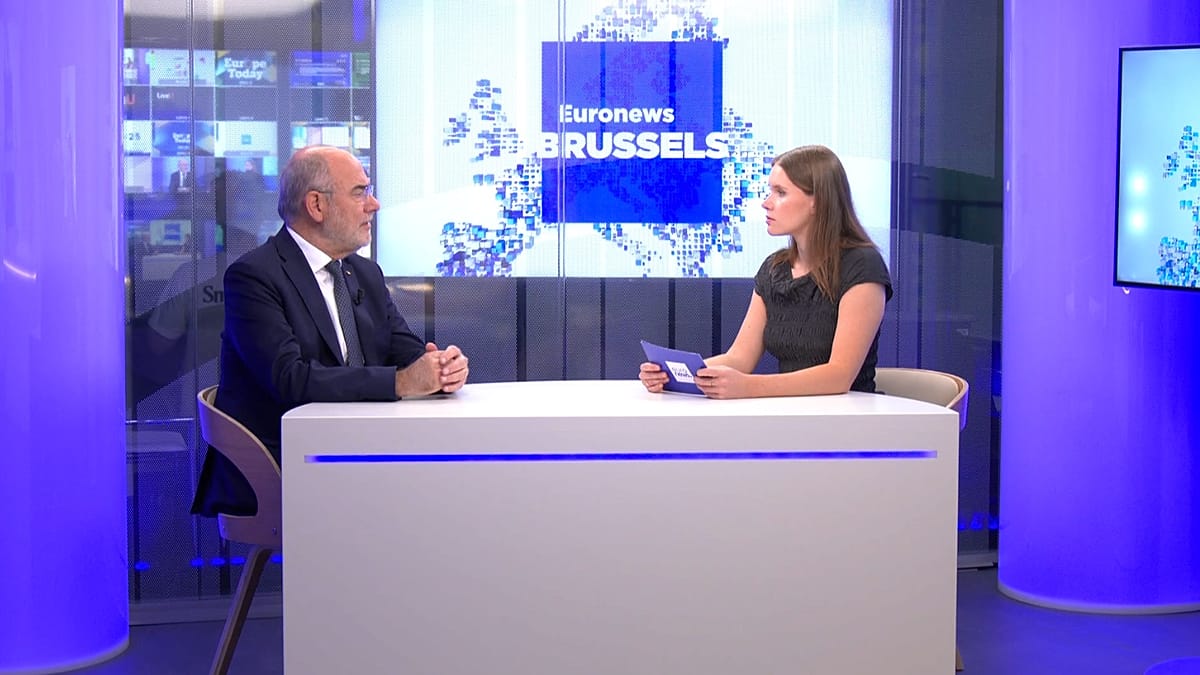
Catalan Minister for the European Union and Foreign Action, Jaume Duch, has told Euronews that the government in Madrid has been “quite smart” when it comes to its response to criticism from the White House and broader international issues, and that generally, it has been more steadfast than the EU.
He pointed to the fact that Spain is often among the first to criticise actions taken by US President Donald Trump. Days into the conflict with Iran, Spanish Prime Minister Pedro Sánchez was the only EU leader to directly challenge the war.
“In the following weeks, this position was also adopted by a majority of EU member states. This means that we were more convinced of our own positions,” the Brussels veteran told Euronews, adding that Catalonia was fully aligned with Madrid on this front.
When asked whether he thinks the EU is wavering on such matters, Duch said the bloc has “evolved a lot” in the last few months.
“I think there was a turning point, namely, all the threats against Greenland,” he said, pointing to President Trump’s push to gain some form of control over the Danish autonomous territory. “This opened the eyes of many governments on this continent, and since then, the positions have changed.”
Spain, as a result of its critical stance towards the US, has repeatedly come under fire from the Trump administration, the latest example being an internal Pentagon email that even suggested suspending its NATO membership as punishment for rejecting calls to assist in the Iran war.
“The Secretary General of NATO [Mark Rutte] said pretty clearly that Spain is doing its job and is taking all its responsibilities within NATO seriously,” Duch, who acts as the link between Brussels and Barcelona, said.
He has raised the question of a “Europeanised” NATO — rebalancing the alliance to minimise EU reliance on the US. “In Brussels, the discussion on this is still very open. In my opinion, it will depend on how the United States behave in the future, whether it will still be a very engaged member,” he said.
The Catalan minister noted that the announcement that the US is set to withdraw around 5,000 troops from Germany “tells us that we need to be prepared ourselves, that we need to be more autonomous.”
Local powers
Shifting to politics on a more local level — Duch, after all, represents Catalonia, not Spain, on the international stage — the regional minister said that while Catalans feel they belong in Europe, there is still a big gap between Barcelona and Brussels.
“There is a need to have answers from Brussels regarding the real difficulties people face, be it housing, social problems, or climate change. We need to narrow the distance between the European institutions and the citizens,” he said.
In his opinion, regions and municipalities can bridge this chasm. “They are closer to the citizens than central governments. This is what we are trying to do. To influence decisions and also help people to understand the importance of being Europeans.”
In a sense, he said, regions are pivotal for European unity and democracy.
“Many of the decisions taken in Brussels […] have to be applied by the regional governments, from agriculture, fisheries, housing. This means that, in reality, what you need is a very good relationship between those who are deciding here in Brussels and those who are implementing the rules on the ground, in this case, in Catalonia.”
Improved relations with Spain
Having a Catalan minister speaking of geopolitics rather than Catalonia’s independence in Brussels would, just a few years ago, have been unimaginable. However, Duch said, things have changed.
In the Catalan regional elections two years ago, the pro-independence movement lost its majority. “The parties in power now think Catalonia belongs in Spain, but at the same time, want to fight for the highest possible level of self-government,” Duch said.
Meanwhile, there is still a desire among Catalans to see their language recognised as an official EU language.
“10 million people speak Catalan in Europe. Catalan is the 13th most spoken language in the EU, which obviously means that we Catalans, we also have the right to see this language become an official language of the EU,” Duch said.
In 2023, Sánchez promised separatist parties that Catalan, Basque, and Galician would be added to the list of official EU languages in exchange for the support needed to form a new minority government. That proposal has still not garnered support in Brussels.
Duch said Catalonia has not lost hope. “We are optimistic. I’m sure that the moment will arrive when our government will have the privilege to announce to the Catalan society that Catalan has become an official EU language.”
He concluded that this is “not related to being independent or not being independent”.
“You don’t need to be independent to get all your rights in the EU. And I even think that it will be much easier to get this recognition being a part of Spain.”
Read the full article here