


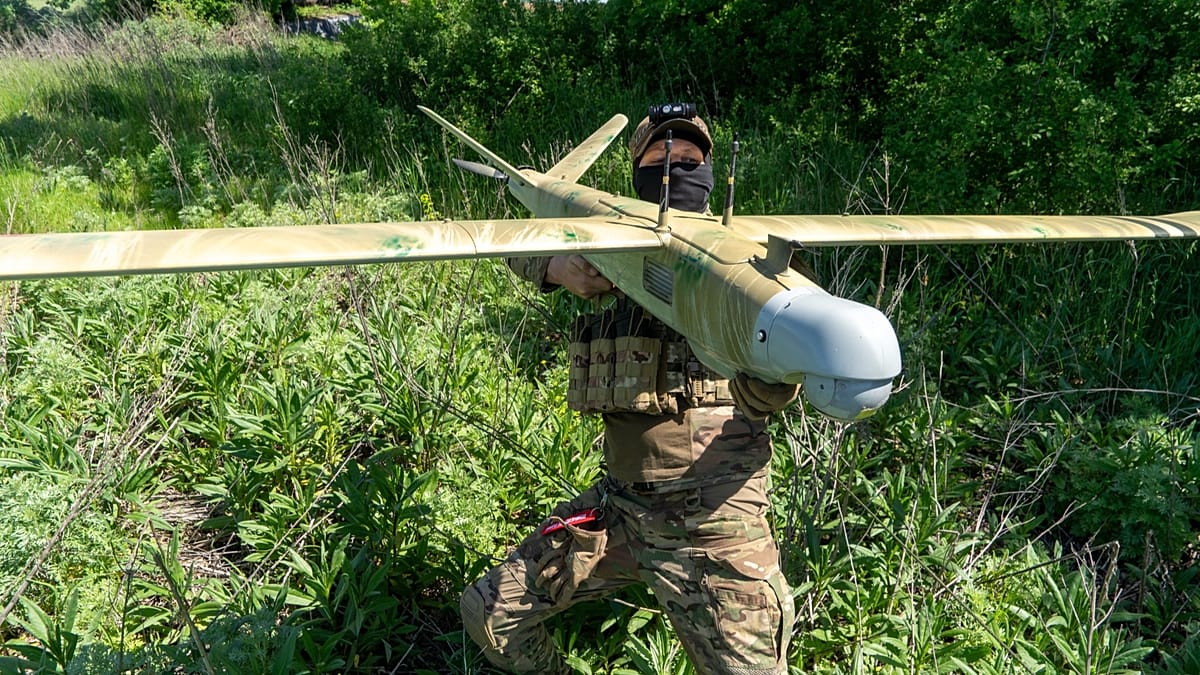
Russia’s full-scale invasion of Ukraine has radically reshaped modern warfare. “In the past year, I’ve seen one tank on the battlefield,” said Corporal Dmytro Zhluktenko, who is responsible for analysing combat lessons within the 413th Unmanned Systems Regiment “RAID” of the Armed Forces of Ukraine.
“When you speak with the German military, they say: you need these tanks because they are the most important thing in war. We don’t think so, as warfare has changed so much since 2022, to the extent that old approaches will not work. Drones can be bought at the last moment, as the technology is continuously changing,” Zhluktenko said during a press briefing organised by the German-Ukrainian Bureau in Berlin.
“I would say that this is a question of approach and doctrine. Some of the approaches to warfare – we think – are a bit outdated.”
Has Germany adapted to modern warfare?
Over the past four years, Russia’s all out war against Ukraine has forced a so-called Zeitenwende or turning point in Germany, with Berlin ramping up defence spending in a bid to rapidly rebuild the Bundeswehr, both in manpower and military hardware.
That push includes traditional heavy weaponry such as battle tanks. By 2027, for example, the battletank brigade 45 in Lithuania is due to receive 123 Leopard 2A8 tanks, alongside several thousand attack drones.
A move in the right direction, but still far from enough, according to four Ukrainian drone officers from the 413th Regiment “RAID” of Ukraine’s Unmanned Systems Forces.
“I saw too many problems in the German army as speaking about drones,” said Captain Oleksandr Voitko, the unit’s deputy Commander.
Voitko added that armies need “as many FPV kamikaze drones as bullets.”
“Bullets are very simple to produce. But you don’t say that you will produce bullets at the last moment. Because the last moment is when you shoot your enemy. I think nobody knows when this last moment will be.”
Voitko argued that while the Bundeswehr possesses some high-tech drone capabilities – including fixed-wing kamikaze drones and long-range reconnaissance systems – it lacks what he described as “the two most effective instruments against enemy infantry.”
FPV kamikaze drones and bomber drones capable of dropping explosives. According to the deputy commander, “80 % of Russian infantry in Ukraine is destroyed by these two types of drones.”
“As I understand, this matter isn’t even on the agenda of the German army now, but it’s the most effective instrument against enemy infantry,” Voitko said.
He added that Germany would need those capabilities in order to defend the Baltic states in the event of a Russian attack. “Right now, Germany is not prepared to face this type of warfare that Russia has mastered in Ukraine,” Zhluktenko added. “There are two militaries in the world right now who are ready and know a lot about drone-centric warfare: Ukraine and Russia.”
“The second problem is that even with these high-tech drones the German army doesn’t have enough,” Voitko explained. According to him, countries such as Russia “can afford very high rates of loss.”
“You need many drones to destroy so many targets that a large army such as the Russian army will suffer,” he said. “You can destroy many targets, even if you have very good drones, but it will be a rate of loss such an army can afford – and you will not win.”
Ukrainian soldiers training German troops
“One very important question is not only the number of drones, but the number of trained pilots,” said Voitko. “I don’t know how many well-trained pilots the German army has now. I don’t think many.” For security reasons, the German military does not disclose how many drone operators it currently has. What is clear, though, is that Germany wants to sharply expand drone training across the armed forces.
The German defence ministry says drone operation is due to become part of basic military training later this year, as the Bundeswehr accelerates efforts to adapt to lessons from Ukraine. The Ukrainian officers believe Kyiv could help train German troops directly. “Yes, we are ready now,” Captain Markiian Yatsyniak, Deputy Commander said when asked whether Ukrainian instructors would be willing to train German soldiers. One option, he emphasised, would be for Ukraine to send certified instructors with frontline experience to Germany.
“The easiest way for us obviously would be to provide it on our soil, so that German troops will arrive in Ukraine and we will provide the full spectrum of training services.”
Only collective defence can guarantee security
In February 2026, the German and Ukrainian defence ministries signed an agreement allowing Ukrainian soldiers to take part in training German troops. Ukrainian fighters with combat experience are now instructing Bundeswehr personnel at army schools in places such as Munster and Ingolstadt, focusing on tactics, drone defence and frontline lessons from the war. “The aim is above all to integrate the experience of Ukrainian soldiers into army training,” a German army spokesperson told the German news agency dpa at the time.
Few further details were made public.
“The army wants to benefit in every area from the experience of the Ukrainian armed forces,” Lieutenant General Dr Christian Freuding, inspector of the German army, told German broadsheet Welt am Sonntag in April.
“Training today must reflect the drone threat, and using drones within our own forces has to become second nature. Right now, there is nobody better to learn this from than the Ukrainians.”
Freuding added that Ukrainian instructors had already been deployed at the armoured corps school, the army’s unmanned systems training centre and the engineer school, with further programmes planned at the artillery school. “We want to roll this out much more widely across the army,” he said.
The Ukrainian officers argued that sharing drone expertise is ultimately about the collective security of Europe and NATO. “We all together are only able to defend ourselves and our continent if we are working together,” Zhluktenko said. “If at least you are as strong as we are at the moment.”
Read the full article here