


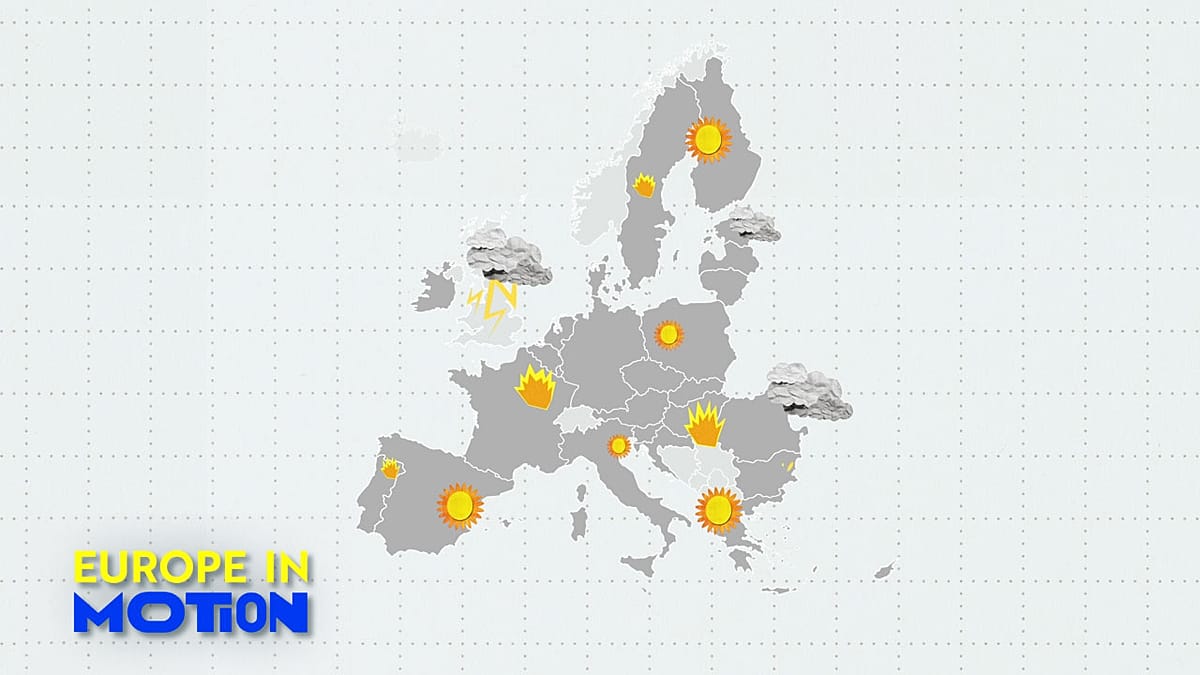
Four out of five Europeans say they have been affected by extreme weather, according to new research by the European Environment Agency (EEA) and Eurofound.
However, different regions face different hazards at varying intensities.
More than 85% of people in southern and central-eastern Europe have experienced climate-related disruption, according to the study, from severe outdoor heatwaves to unbearable indoor temperatures.
Wildfires and their smoke were reported by 41% of respondents in Greece, 35% in Portugal and 20% in Cyprus, against a European average of just 8%.
Currently, southern Europe is battling wildfires, with these extreme weather events forcing thousands of people to evacuate their homes and prompting officials to ban spectators from a portion of the Tour de France cycling race.
On 3 July, the satellites of Copernicus, the European Union’s Earth observation programme, captured a smoke plume drifting westwards over the Atlantic Ocean from the wildfires spread across north-west Portugal.
On the other hand, nearly 26% of respondents in Austria and 19% in Slovenia reported being affected by flooding, compared with an EU-wide average of 11%.
What factors shape the impact of extreme climate events?
A person’s income, housing and health also play a part in how severely extreme climate events impact them.
For instance, nearly 40% of Europeans cannot afford to keep their homes cool during summer heat peaks.
The highest percentage of respondents unable to afford keeping their home cool in the summer was found in central-eastern Europe at 46.1% compared to 30.1% in northern Europe.
For households struggling to make ends meet, this figure rises to over 66%, prompting significant levels of worry about the future across Europe.
More than 60% of people in the southern part of the continent report deep concern about future temperature extremes.
This is more than double the level recorded in northern Europe.
Meanwhile, in central–eastern Europe, more than half of respondents are worried about access to safe water for daily use, against fewer than a quarter in the north of Europe.
Read the full article here