


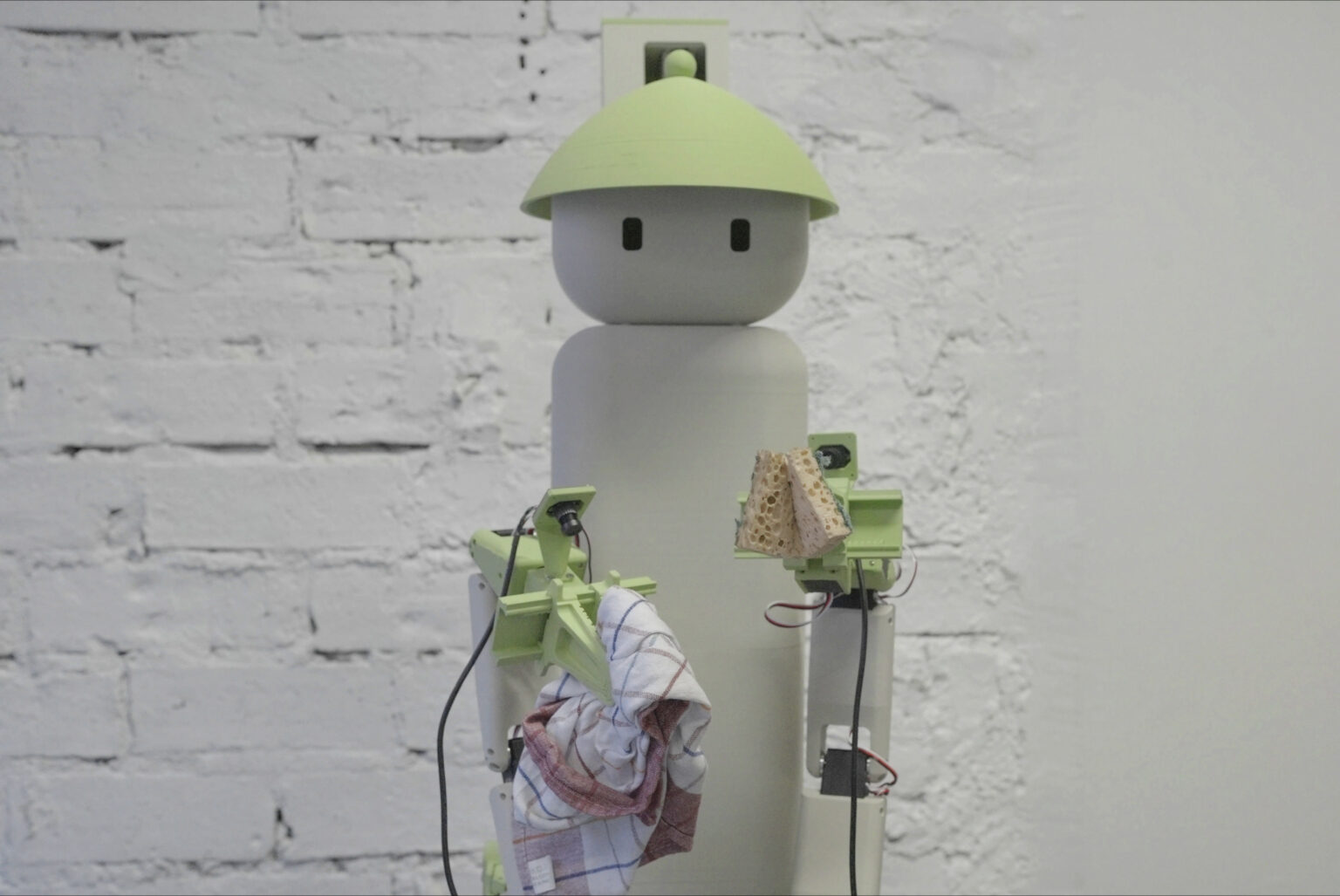
A humanoid robot that costs under $4,000 sounds too good to be true. But that’s the price that Flourish Robots, a humanoid robot startup, has announced for its ready-to-ship Flourish 1 unit. At $3,555, the Flourish 1 home robot would be the cheapest humanoid robot I’ve heard of.
Starting Tuesday, the company is accepting preorders for the first 50 units, with deliveries expected in December. There will also be an optional subscription that covers cloud compute for some AI features.
“It’s a product launch, not a paid beta,” Flourish CEO Antoine Marcel said in an email. “At this point, the main dependency is supply chain rather than fundamental R&D. The robots are already in the manufacturing and assembly process. Some components, particularly the batteries, have production lead times of around two months, so the main job between now and December is making sure all of those parts arrive on schedule and completing assembly and testing.”
What can the Flourish 1 actually do?
The Flourish 1 is designed to handle many repetitive household tasks, like picking up and sorting items, watering plants and even scooping cat litter.
On top of that, the company says the Flourish 1 robot is also able to learn any household task in just 30 minutes using the mobile app, no coding required.
By using your phone as a proxy object — like sliding it across a table to demonstrate wiping it down — you act as a teleoperator for your robot, teaching it through direct mirroring until it can perform the task autonomously. Once it’s seen the task demonstrated and an hour has passed for the robot to internalize the new process, the Flourish 1 notifies you that it’s ready to perform or schedule the task on its own.
The Flourish 1 can repeat and schedule tasks such as picking up clothing or toys, loading a dishwasher, wiping tables, watering plants and cleaning a cat litter box. Marcel, Flourish’s CEO, says the robot isn’t just learning to record and replay movements. AI is involved to help it generalize, within certain limitations.
“If you teach Flourish 1 something like, ‘put the shoes into the shoe cabinet,’ you’re teaching it the task, not a fixed sequence of coordinates. The goal is for the robot to understand what it needs to find and what outcome it needs to achieve,” said Marcel. “So the shoes don’t need to be in exactly the same place every day. The perception system finds them in the environment, and the robot adapts its movements accordingly.”
Teaching by demonstration not only introduces the model to new tasks but also allows you to tailor its capabilities to entirely different uses.
Marcel says that in normal operation, there’s no human operator remotely controlling the robot. Other humanoid robot companies, such as 1x and Weave, employ teleoperators for tasks their robots can’t complete without a human in the loop.
The video below shows the Flourish 1 performing such tasks as cleaning and wiping down countertops. It can even bring you a beer.
However, there are also things it can’t do. The company says it shouldn’t be sent into water, shouldn’t carry something heavier than 1.5 kg (3.3 pounds) or anything breakable and can’t handle stairs.
And don’t expect it to babysit your toddler. The website warns, “It works around your kids. It doesn’t look after them.”
The robot itself stands 3 feet 7 inches tall, has what appears to be a telescoping torso, weighs 44 pounds and has a reach of 35 inches. It can run for 12 hours.
Although it can’t babysit, the robot is designed to operate safely in a home with people and pets, with built-in safeguards.
“The robot is designed to stop its motion when it detects a person or animal entering its working area, rather than continuing the task,” Marcel says. “We also deliberately chose a stable wheeled platform rather than a dynamically balancing biped, and limited the payload and power of the arms. Those decisions aren’t only about cost — they also reduce the amount of energy involved when the robot is operating around people.”
For privacy, Marcel says the company is designing a system that leaves customers in control of their data. In the mobile app, customers can opt out of sharing data to train models.
Is this actually coming to market at this price?
As someone who’s covered robots extensively for CNET, the $3,555 price strikes me as optimistic on the company’s part, especially given what sounds like a limited production run of just 50 units.
For context, the fully humanoid 1x Neo, a robot from a different company, is expected to cost $20,000 to own or $499 per month to rent as part of a subscription. It’s supposed to be available this year.
Weave’s Isaac 1, which costs $7,999 up front or $449 per month as a subscription, is also up for preorder and is scheduled to start delivering to California in fall 2026, with broader US availability in 2027.
A humanoid robot that costs under $10,000 is the highest price I consider affordable for the average consumer, but unrealistic given production costs. Flourish intends to offer its Flourish 1 at a lower price than either 1x or Weave.
Flourish’s CEO says the company can do this by making engineering choices different from those of standard humanoid robot platforms, and that it’s not selling the units at a loss.
“Some humanoid platforms add legs that can represent tens of thousands of dollars in hardware, or build arms designed to carry 10 kg and operate in industrial environments,” Marcel says. “For household tasks, we don’t think you need that. Flourish 1 uses a wheeled base and relatively lightweight arms designed around the payloads you actually encounter at home. That dramatically reduces the cost and complexity.”
In this regard, Flourish’s design philosophy more closely resembles Weave’s Isaac 1 than 1x’s Neo, though there’s still a fairly substantial price differential between the two models.
The limited initial production run may be the biggest challenge. The first 50 units will be built and assembled directly by Flourish. Still, the company says to move beyond the initial run, it’ll need to work on industrializing the product and expanding manufacturing capacity.

See full bio
Read the full article here